
Quick Answer: Korean cosmetic labels need readable Korean particulars on the appropriate packaging, supported by the final formula, local business details, batch and use-period information, warnings and applicable functional designation. Review the bottle and carton together. Small packs have defined exceptions rather than a general exemption, and an English ingredient list alone does not complete the Korean label review.
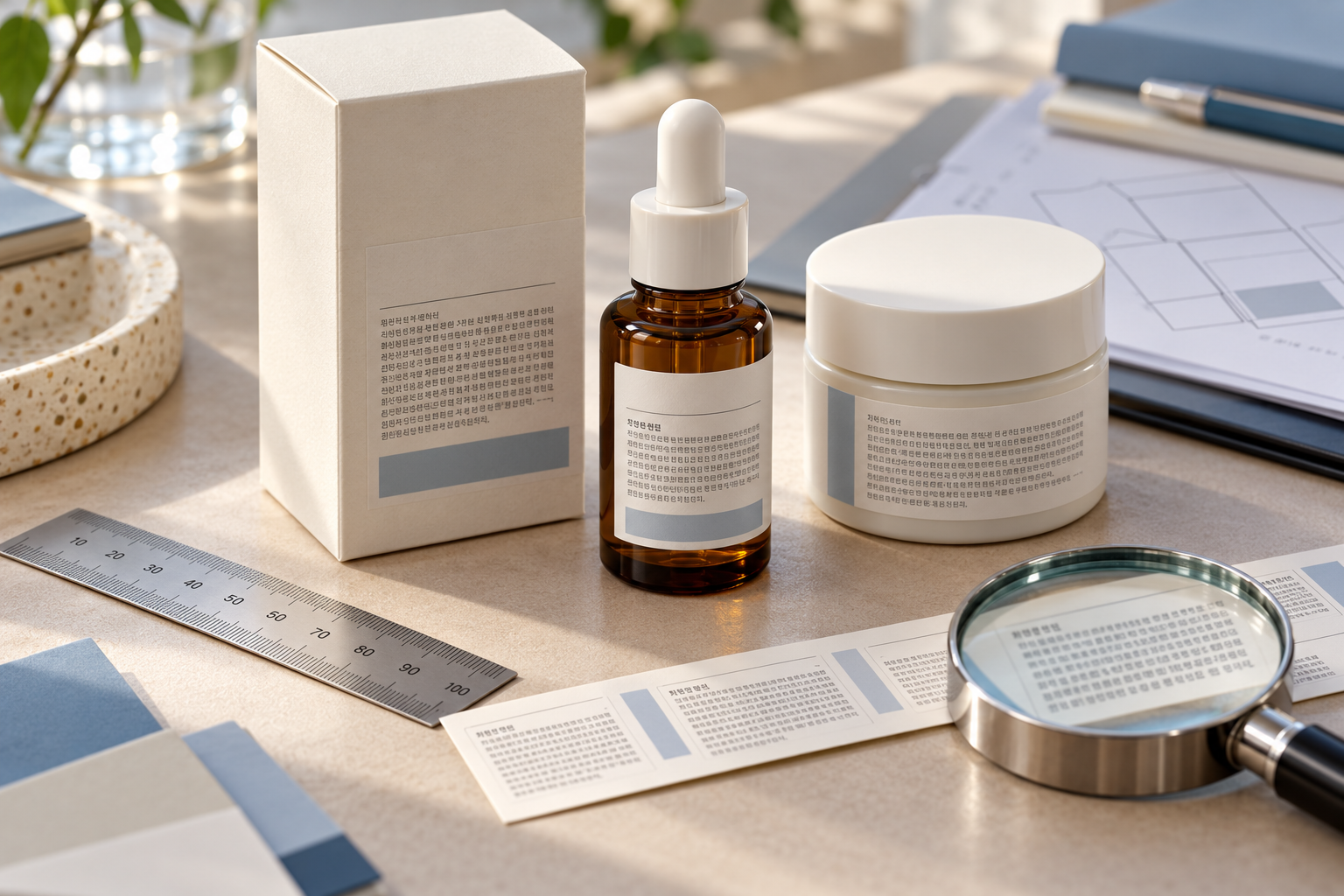
Start with the current law and the actual sales pack
This guide concerns cosmetics supplied for sale in South Korea. Start with Cosmetics Act Articles 10–12 in the version effective 20 October 2026 and the applicable Enforcement Rule. Record the version used, the planned sale date and the SKU. The law database may include future-effective provisions; an announced reform or later commencement date should be a planning item until it actually applies.
Build the assessment around a complete physical pack, including the immediate container, carton, sachet, insert and any label applied after import. Describe which components consumers receive and which remain with the product during use. The same formula sold as a jar, travel tube and gift set needs separate packaging checks.
The Korean cosmetic regulations guide explains the broader compliance layers. Label approval should sit alongside classification, formula assessment and local quality arrangements. Give the reviewer a stable product brief before asking for a final verdict, because a changing product name or claim can make yesterday’s proof obsolete.
| Information group | Source for the review | Practical check |
|---|---|---|
| Identity and businesses | Final product name and verified operator records | Match legal entities across packaging and import records |
| Composition and quantity | Controlled formula and filling specification | Reconcile ingredient text and each pack size |
| Traceability and useful life | Batch system and substantiated dating decision | Keep codes distinct, readable and reproducible |
| Consumer use and claims | Intended use, warnings and functional route | Review wording across pack and online content |
Separate outer-pack particulars from container particulars
Article 10 identifies the information for the external packaging: product name, business name and address, ingredients subject to permitted omissions, net quantity, batch identifier, expiry or period after opening, price, applicable functional designation, precautions and further prescribed items. Price marking is connected to the seller’s selling price under Article 11; agree how the retail arrangement handles it.
When a secondary pack is added, Article 10 also identifies a shorter set for the primary container: product name, operator name, batch number and expiry or period after opening. The Act includes a specific exception for prescribed products such as qualifying cosmetic soap whose primary wrapping is removed for use. Do not extend that exception to an ordinary bottle or jar.
Create an annotated dieline showing each required element and the rule relied on. A carton does not automatically cure missing container information. Conversely, repeating every paragraph on a tiny bottle may create unreadable print. Resolve the legal placement first, then design the layout around the approved allocation.
For imported cosmetics, Enforcement Rule Article 19 adds manufacturing-country and foreign manufacturer information, with a stated country-of-origin marking exception. Have the Korean reviewer reconcile these details with the actual supply chain. A brand headquarters address and a contract manufacturing site describe different entities and should not be swapped casually.
Make Korean instructions work as complete sentences
Article 12 requires accurate, readable and understandable Korean in a readily visible location; other languages can accompany it. Keep English branding and ingredient references coordinated with the Korean text. A consumer should not have to infer the intended direction from two inconsistent language versions.
Use a competent Korean reviewer for the joined product name, directions, cautions and ingredient statement. Supply the actual use area, whether the product is left on or rinsed off, intended users and packaging method. A translated fragment such as avoid contact may become ambiguous when it is joined with a linked clause or a separate warning.
Proofread at actual print size and on the real background colour. Check curvature, seams, reflective finishes and transparent bottles filled with the intended product. These are practical design controls: a good screen preview can still become difficult to read on a small curved tube. Retain the text master and a photograph of the approved production sample.
| Workstream | Manufacturer contribution | Brand and Korean operator action |
|---|---|---|
| Formula text | Complete composition and constituent details | Verify local naming and final ingredient statement |
| Business particulars | Accurate manufacturing entity and site data | Confirm registered local entities and imported-product details |
| Dating and coding | Specifications, studies and code method | Approve wording, placement and batch reconciliation |
| Artwork release | Dieline, material and representative sample | Approve joined Korean text and retain the signed revision |
Build ingredient text from the controlled formula
Use the final formula revision as the source. Expand premixes sufficiently for the reviewer to identify the constituent ingredients, and reconcile supplier trade names with the names used on the Korean label. A raw-material brochure or an earlier ingredient list is an unreliable basis for a production proof.
The rules provide limited ingredient omissions, including material removed during manufacture and certain incidental constituents present below an effective amount. Treat an omission as a documented regulatory decision. It should not become a way to conceal an ingredient because its name is long or the label is crowded.
Ask the reviewer to apply the detailed naming, order and presentation rules in the relevant annex, including any fragrance constituent requirements. Keep the calculation behind the approved list so another reviewer can reproduce it. If the factory changes a preservative blend, obtain the revised constituent information before assuming that the printed list remains accurate.
For a manufacturing handoff, ask the OEM/ODM cosmetics manufacturer for the composition revision, pack specifications and sample code alongside the artwork. This creates a clear connection between the manufactured product and the consumer information. Keep confidential quantitative data in controlled records while giving the local reviewer the access needed for its assessment.
Apply small-pack exceptions narrowly
Rule Article 19 distinguishes packs containing no more than 10 mL or 10 g, excluding designated products needing special caution, and qualifying trial products not intended for sale. The Act permits a reduced set of particulars for prescribed packs; it does not make these products unlabelled or remove traceability requirements.
A separate provision covers certain packs above 10 and up to 50 mL or g. It permits specified ingredient omissions while retaining listed categories, such as restricted ingredients and relevant functional ingredients. This is a different mechanism from the smallest-pack exception. Check the exact product and exclusions before reducing the ingredient statement.
Where the relevant ingredient omission is used, Article 19 requires a way for consumers to check the omitted ingredients, such as the prescribed telephone or website information on the packaging or a complete printed list available at the sales outlet. Keep that access route current and test it before release.
Prepare a separate exception record for every affected SKU. Include size, product category, the exact permitted omission, remaining text and the access mechanism. A 10 mL sample and a 30 mL retail serum should not inherit the same artwork merely because they belong to one range. Trial status also needs to reflect how the item is actually distributed.
| Pack scenario | Review focus | Release evidence |
|---|---|---|
| Standard retail pack | Full applicable particulars and primary/secondary allocation | Approved complete pack proof |
| At most 10 mL or 10 g | Eligibility, caution exclusions and reduced particulars | Product-specific exception record |
| Above 10 to 50 mL or g | Limited ingredient omissions and retained categories | Ingredient assessment and consumer access route |
| Trial product or gift set | Actual distribution purpose and each component | Set proof, codes and agreed information placement |
Keep warnings and functional claims product specific
Article 19 points to Annex 3 for precautions. Have the reviewer select the warnings for the actual formula, product category, use method and intended users. Do not copy a neighbouring SKU’s warning panel solely because its carton has the same dimensions. Keep the approved source and reasoning with the artwork.
For functional cosmetics, Article 19 addresses the examined or reported benefits and directions. The MFDS functional cosmetics overview explains the separate examination or reporting framework. The functional designation on a label needs to agree with the applicable product route and evidence. It is not a general endorsement of the manufacturer or every product in a range.
Some functional categories also require a statement that the product is not a medicine for prevention or treatment of disease, with detailed presentation conditions. Escalate the exact category and proposed wording to the Korean reviewer. Avoid medicinal implications elsewhere on the pack, including product names, diagrams and before-and-after descriptions.
The brand should review e-commerce copy and retailer content against the same approved claims brief. A cautious carton can be undermined by exaggerated online promises. Keep evidence for factual statements, and reopen review when marketing adds a benefit, changes the intended user or broadens the use area.
Release artwork through a repeatable production check
Use three approvals: the text master, the final dieline and the representative finished pack. Each should carry a revision, date and named reviewer. Compare the printed sample with the approved formula, business details and code specification rather than checking only that the designer used the latest PDF.
Test any applied sticker for adhesion, contrast and interference with existing particulars. Confirm that it does not hide the batch or dating information and that the consumer can read it under ordinary handling. Photograph all sides and retain an example from the first accepted run.
The South Korean market launch guide can help connect packaging release with local operating responsibilities. Before production, assign who supplies the label data, who authorises printing and who inspects incoming stock. The manufacturer, brand and Korean responsible operator need a common escalation path when a discrepancy appears.
When a formula, supplier, manufacturing site, pack size, claim or law changes, record the effect on existing stock and future artwork. Do not silently replace a text file and lose the reason for the change. For a packaging project, contact the project team with the SKU list, current dielines and the specific unresolved questions so the technical handoff can be scoped accurately.
Frequently asked questions
Can an English label be used for Korean retail sales?
Required particulars need accurate, understandable Korean. English can accompany the Korean text, but the full pack must satisfy the applicable Korean placement and presentation rules.
Does every bottle need the full carton text?
No. The Act distinguishes the external pack and the primary container when secondary packaging is added. Review the required information for each component and any specific exception.
Are 10 mL samples exempt from labeling?
No. Defined small-pack and trial-product provisions permit reduced particulars under conditions. Check caution exclusions, retained information and access to any omitted ingredients.
Can a Korean sticker be approved after production?
Plan and approve its wording and placement before committing the packaging run. Check the actual sample for readability, adhesion and interference with codes or other required information.
Who should approve the final Korean artwork?
The brand should coordinate a competent Korean label review with the responsible local operator and accurate manufacturer records. Retain the joined text, approved dieline and finished-pack evidence.
Last reviewed: 27 October 2026. General planning information, not product-specific legal or safety advice. Confirm the applicable current requirements, category and packaging arrangement with a qualified Korean adviser before import or sale.