Skincare manufacturing cost is one of the first questions buyers ask, but it is also one of the easiest areas to misunderstand. A serum, cream, cleanser, mask, or toner can look simple from the outside while the final price depends on formula route, raw materials, packaging, testing, order quantity, decoration, and export requirements.
This guide explains how overseas beauty brands, Amazon sellers, DTC teams, distributors, and private label buyers can think about skincare manufacturing cost before requesting a quotation from a cosmetic OEM manufacturer or cosmetic ODM manufacturer. Mooyam Cosmetic supports brand and wholesale OEM/ODM projects; we do not accept retail orders.
Quick Summary
- Skincare cost is built from formula, packaging, MOQ, testing, labor, filling, decoration, cartons, and logistics preparation.
- Stock formulas and standard packaging usually control cost better than fully custom formulation and custom molds.
- Low MOQ can reduce launch risk, but unit cost is normally higher because setup and purchasing minimums are spread across fewer units.
- Quality control, stability checks, packaging compatibility, and documentation should be budgeted as part of the project, not treated as extras.
- A clear brief helps a manufacturer quote accurately and avoid repeated sample changes.
What Makes Up Skincare Manufacturing Cost?
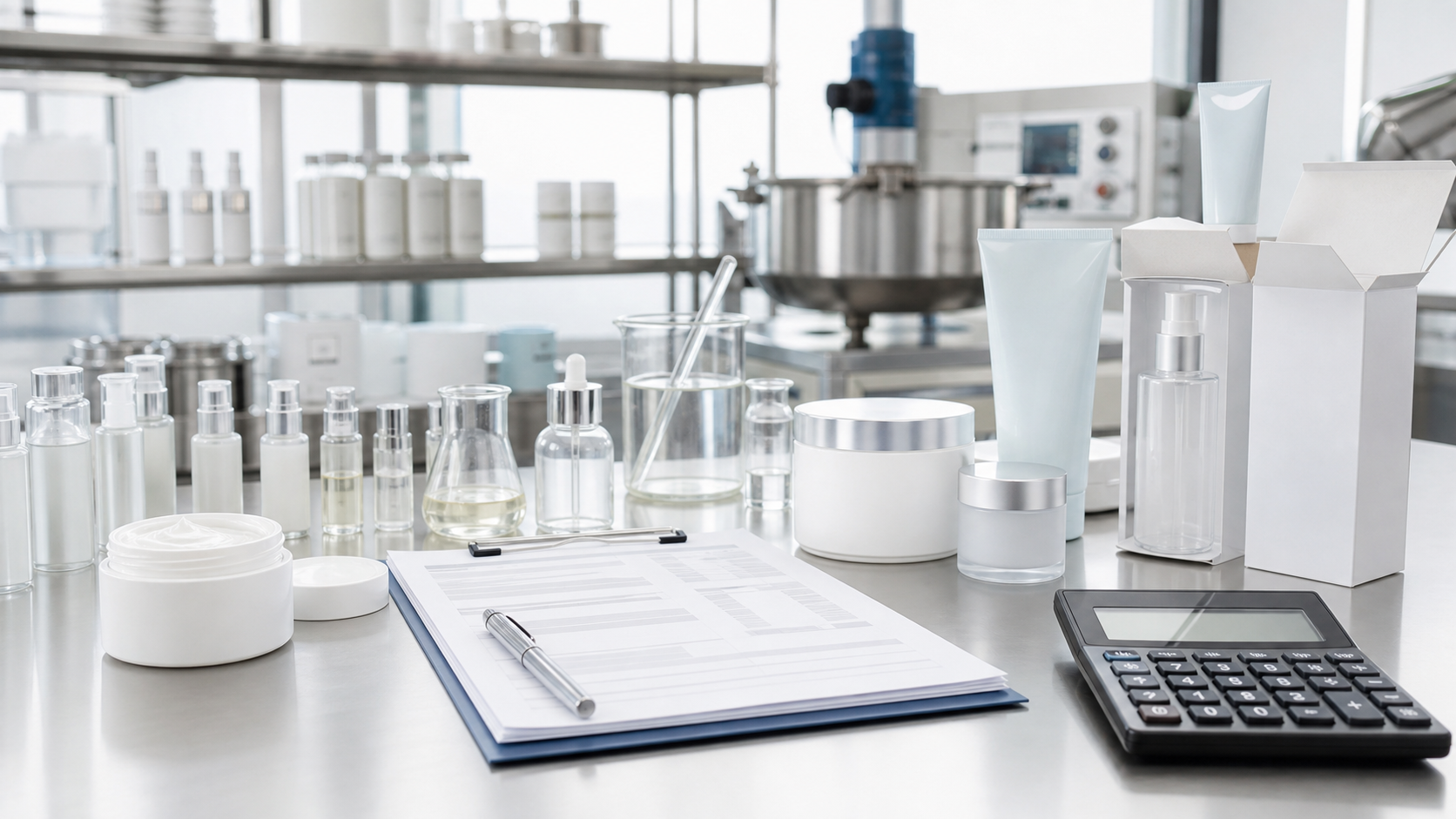
The final factory price is not only the cost of cream or liquid inside the bottle. For most private label skincare projects, the quoted unit price combines multiple workstreams: formula development or formula selection, raw material purchasing, packaging sourcing, printing, filling, assembly, inspection, cartons, and export preparation.
A buyer choosing a ready base formula with a standard bottle will usually receive a different cost structure from a buyer requesting custom formulation, special actives, custom fragrance, a decorated airless pump, a printed box, and market-specific document support. Both can be valid, but they should not be compared as if they were the same project.
Core Cost Drivers Buyers Should Understand
Formula route
A private label skincare formula based on an existing factory base may shorten sampling time and lower development cost. A fully custom formulation gives more control over texture, ingredient story, claim direction, fragrance, and positioning, but it may require more lab work, more sample revisions, stability screening, and special raw material purchasing.
Ingredient selection
Cost can change quickly when a formula uses high-priced oils, peptides, ferments, encapsulated systems, specialty surfactants, botanical extracts, or imported raw materials. The question is not whether expensive ingredients are good or bad; the question is whether they support the product concept, target price, and evidence available for the claims in the target market.
Packaging sourcing
Packaging often influences cost as much as formula. Bottles, jars, tubes, airless pumps, droppers, caps, labels, boxes, inserts, and decoration methods each have their own MOQ. Brands can review Mooyam Cosmetic’s customized packaging support when comparing stock packs, decorated packs, and more customized options.
| Cost Area | What It Includes | Buyer Decision |
|---|---|---|
| Formula | Base formula, custom formulation work, actives, fragrance, preservation, texture adjustment | Choose stock, modified, or fully custom route |
| Packaging | Bottle, jar, tube, pump, cap, label, box, printing, decoration | Balance brand image with MOQ and component lead time |
| MOQ | Raw material minimums, packaging minimums, line setup, purchasing efficiency | Decide launch quantity and inventory risk tolerance |
| Quality Control | Incoming checks, filling controls, appearance checks, pH/viscosity, microbiology where relevant | Define specifications before bulk production |
| Export Support | Carton marking, packing list, invoice, shipping coordination, product documents where applicable | Confirm destination market and importer needs early |
How MOQ Changes Unit Cost
MOQ affects pricing because many costs are fixed or semi-fixed. Machine setup, sample confirmation, artwork preparation, raw material purchasing, component sourcing, and quality control time do not disappear when order quantity is small. With low MOQ production, those costs are shared across fewer units, so the unit price is often higher.
That does not mean low MOQ is a bad decision. For startups and DTC brands, a lower first run can reduce inventory pressure and help test market response. The practical goal is to choose a launch quantity that fits cash flow while still giving the project a workable production route. Mooyam Cosmetic’s OEM/ODM service can help buyers compare options before committing to bulk production.
Custom Formulation vs Private Label Cost
A private label route can be useful when a brand wants to launch faster with a proven base, adjust packaging, and focus on branding and sales. A custom route is better when the buyer has a defined texture, ingredient strategy, performance target, or market position that cannot be met by an existing formula.
For many buyers, the right answer is a practical middle path: start with a qualified base, then adjust sensorial feel, fragrance, hero ingredients, or packaging. Brands that need deeper R&D can explore Mooyam Cosmetic’s custom formulation support to align the brief with sample development, testing, and scale-up.
Testing and Quality Control Should Be in the Budget
Some buyers try to reduce cost by cutting validation, but that can create greater risk later. Cosmetic products should be evaluated for appearance, odor, color, pH, viscosity, fill weight, packaging compatibility, and microbiological quality where applicable. Stability and compatibility expectations vary by formula type and target market, so the plan should be discussed before production.
Mooyam Cosmetic’s quality control and compliance FAQ explains how quality checks and documentation support buyers. A responsible cosmetic manufacturer should help the buyer understand what can be controlled at factory level and what must be confirmed by the brand or importer for the destination market.
How to Request a More Accurate Quotation
A quotation is only as accurate as the brief behind it. If the inquiry says only “send price for moisturizer,” the manufacturer must guess the texture, bottle, volume, fragrance, claim direction, carton, quantity, and destination. That usually leads to a wide estimate or repeated revisions.
Before contacting a supplier, prepare the product category, fill volume, target quantity, preferred formula route, ingredient priorities, packaging reference, sales market, desired launch date, and target price range. Buyers who are still comparing product directions can review Mooyam Cosmetic’s private label skincare service for a clearer starting point.
Buyer Checklist Before Budgeting
- Product type, size, texture, fragrance direction, and target skin-feel
- Private label, modified base, or custom formulation route
- Hero ingredients and ingredients to avoid
- Packaging format, decoration method, box requirement, and carton needs
- Expected order quantity, low MOQ requirement, and target unit cost
- Destination market, language, importer requirements, and required documents
- Sample approval timeline, bulk production timeline, and launch deadline
Common Cost Mistakes to Avoid
Do not compare quotes only by the lowest unit price. One supplier may include better packaging, stronger quality control, clearer export support, or more practical sample development, while another may omit important details. Also avoid changing packaging, fragrance, active levels, or claims after stability work begins; late changes often increase cost and delay production.
Another common mistake is asking for premium packaging with very low MOQ without understanding component minimums. A standard bottle with label decoration may support a small launch better than a fully customized mold or complex surface finish. A good supplier should explain these tradeoffs directly.
Plan Your Skincare Manufacturing Budget with Mooyam Cosmetic
Looking for a reliable cosmetic OEM/ODM manufacturer? Mooyam Cosmetic can help with private label skincare, custom formulation, low MOQ planning, packaging sourcing, sample development, bulk production, quality control, and export support.
Share your product idea, target quantity, formula requirements, packaging direction, and launch market through our contact page. We will help evaluate a practical manufacturing solution for brand and wholesale projects.
Frequently Asked Questions
What is the biggest factor in skincare manufacturing cost?
There is no single factor for every project. Formula complexity, packaging choice, MOQ, decoration, testing, and destination-market support can all affect cost. Packaging and MOQ are often underestimated by new buyers.
Is private label skincare cheaper than custom formulation?
Usually it is more cost-efficient and faster because the base formula already exists. However, a modified or custom formula may be better if the brand needs a specific texture, ingredient story, or market position.
Can low MOQ production still be profitable?
Yes, if the brand prices correctly and treats the first order as market validation. Low MOQ often has a higher unit cost, so buyers should plan margin, freight, samples, marketing, and platform fees carefully.
Why do two manufacturers quote very different prices?
They may be quoting different formula grades, packaging components, decoration methods, testing assumptions, MOQ levels, or included services. Ask each supplier to clarify what is included before comparing.
Should testing be included in my budget?
Yes. Stability, compatibility, microbiology, and other checks may be needed depending on product type and target market. Requirements vary by destination and should be confirmed before production.
Can Mooyam Cosmetic help with both formula and packaging?
Yes. Mooyam Cosmetic supports formula development, private label options, packaging sourcing, sample development, quality control, and export coordination for B2B skincare projects.