
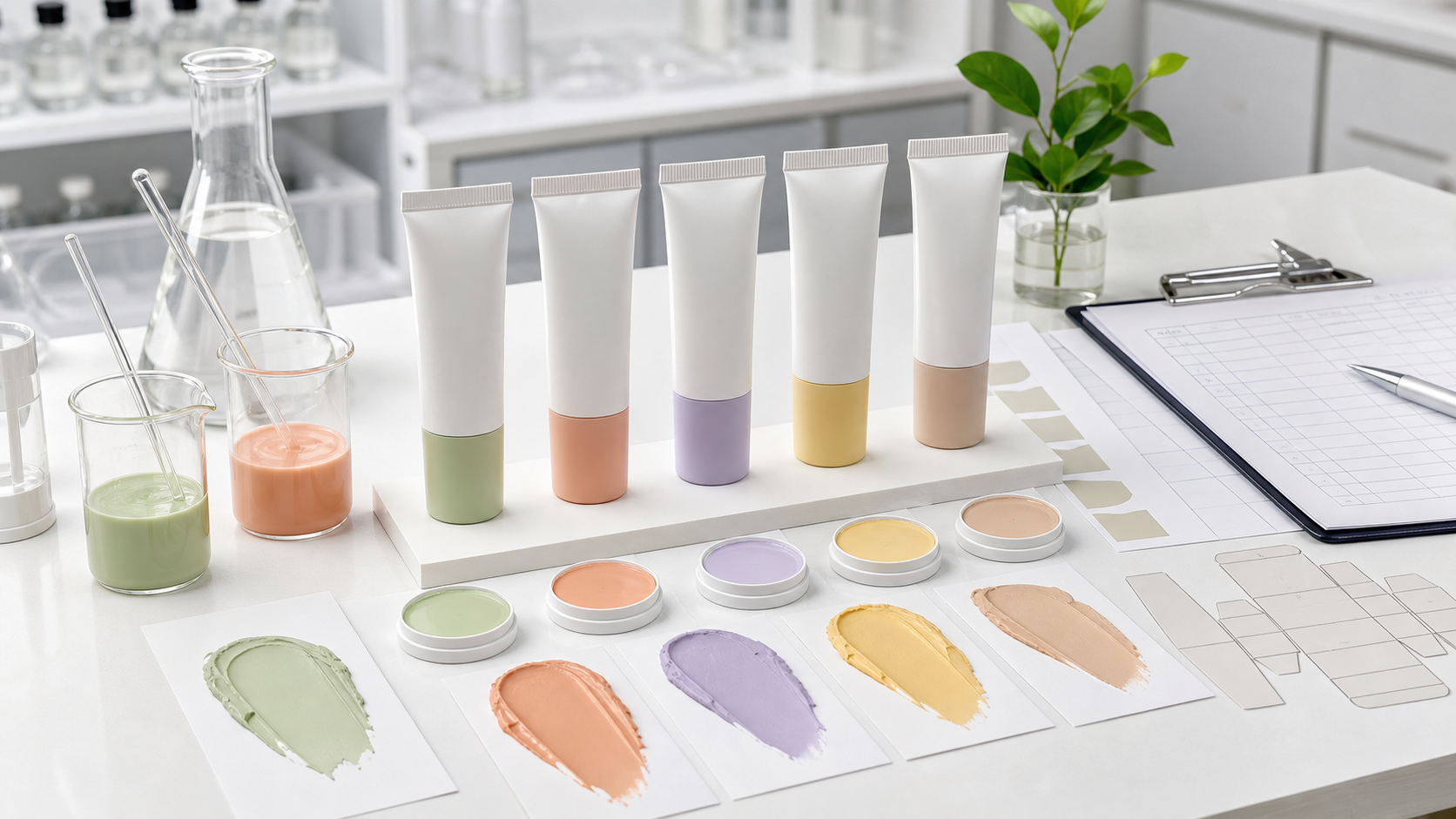
Color corrector products help beauty brands build practical base-makeup routines around redness, dullness, dark circles, uneven tone and visible discoloration. For OEM/ODM buyers, the value is not only the pastel color story; the product must deliver controlled correction, comfortable wear and packaging that protects the formula.
This guide explains how brands can develop color corrector creams, tubes, palettes or primer hybrids with Mooyam Cosmetic. Mooyam Cosmetic is a cosmetics and color makeup OEM/ODM factory for brand projects; we do not accept retail orders.
Quick Summary
- Color corrector, concealer, primer and skin tint searches show continuing interest in complexion products and routine-building base makeup.
- OEM/ODM development should translate green, peach, lavender, yellow and beige correction logic into stable formulas and realistic claims.
- Brands need to decide whether the product should be a tube cream, palette pan, primer hybrid, wand concealer or multi-shade kit.
- Mooyam Cosmetic supports shade development, texture sampling, packaging selection, stability review, QC and bulk production.
Why Color Correctors Fit Base-Makeup Launches
Color corrector products sit between skincare, primer and concealer. They help a brand offer targeted base solutions without relying only on foundation shades. A green corrector can help visually neutralize redness, peach and orange tones can support the look of under-eye correction, lavender can brighten dull-looking complexions, yellow can soften purple-toned areas, and beige can blend correction into a more natural finish.
For B2B buyers, this category is useful because it can be launched as one hero SKU, a four-shade palette, a primer-corrector range or a complexion prep set. It also creates internal linking opportunities with concealer, skin tint, foundation, setting powder and primer products. The challenge is to avoid making unsupported treatment claims and focus on cosmetic appearance benefits.
Mooyam Cosmetic helps brands turn a trend-led concept into a manufacturable product brief. We look at shade payoff, pigment dispersion, texture, skin feel, packaging compatibility, stability, fill process and quality control before bulk production.
Choose the Right Color Corrector Format
The right format depends on the use case. A tube cream is easy for targeted application, a palette can offer multiple colors for professional or creator brands, and a primer hybrid can be positioned as a daily prep product. Wand or doe-foot packaging may feel familiar to concealer users, but it needs careful viscosity and wiper matching.
| Format | Best Use Case | Development Focus |
|---|---|---|
| Tube corrector cream | Targeted redness, dullness or under-eye correction | Viscosity, pigment load, tube compatibility, easy blending |
| Multi-shade palette | Makeup artist kits and education-driven brands | Pan texture, shade balance, sweating control, formula uniformity |
| Primer hybrid | Daily prep, tone-correction and base smoothing | Spreadability, lightweight feel, foundation compatibility |
| Wand corrector | Concealer-style application and shade expansion | Wiper fit, applicator pickup, coverage, dry-down |
Shade Logic for OEM/ODM Buyers
Color corrector shade development should start with the target concern and skin-tone range. Green should not look chalky after blending. Peach should be balanced enough for under-eye use without becoming orange on fair skin or disappearing on deeper skin. Lavender should brighten visually without looking gray. Yellow should soften the appearance of purple areas without turning the base too warm.
For a first launch, a brand may choose one universal green corrector, a peach under-eye corrector and a lavender brightening corrector. A larger launch may include multiple peach-to-orange levels, a neutral beige mixer and a yellow tone. The selected shades should be reviewed on different skin tones and under both natural and studio lighting.
Formula Texture and Wear
Texture decides whether customers can use the corrector under foundation, concealer or skin tint. The formula should spread thinly, avoid patching, resist pilling, and provide enough color payoff to correct without creating a heavy pastel cast. For primer hybrids, compatibility with silicone-based, water-based and emulsion foundation systems should be considered during sampling.
Packaging and Labeling Considerations
Packaging affects formula stability and consumer use. Tubes can protect creamy formulas and allow hygienic dispensing. Palettes need pan stability and a controlled texture that does not sweat or crack. Wand packaging needs a stable fill weight, suitable wiper and applicator material. Airless pumps may be considered for lighter primer-corrector textures, but cost and MOQ should be reviewed early.
Labels and cartons should clearly describe cosmetic use, shade name, net content, ingredient list and responsible company information according to the target market. For color cosmetic products, brands should also check whether color additives and shade components are suitable for the intended market and application area.
OEM/ODM Development Flow
| Step | Brand Input | Mooyam Cosmetic Support |
|---|---|---|
| 1. Concept brief | Target concern, shades, texture and claims | Formula route, shade plan and packaging advice |
| 2. Lab sampling | Benchmark texture, coverage and blend preference | Sample batches, color matching and texture adjustment |
| 3. Package match | Tube, palette, wand, airless pump or kit choice | Filling, compatibility, leakage and stability review |
| 4. Production | Final approval, artwork, PO and launch timing | Bulk manufacturing, QC, packing and shipment preparation |
Buyer Checklist
- Define the format: tube cream, palette, primer hybrid, wand corrector or kit.
- Choose shade logic: green, peach, orange, lavender, yellow, beige or custom tones.
- Decide finish and feel: natural, satin, soft-matte, hydrating or primer-like.
- Prepare benchmark products for texture, coverage, blend time and dry-down.
- Test on different skin tones and under multiple lighting conditions.
- Check pilling, separation, sweating, color drift, odor, leakage and fill weight.
- Review color additive suitability, label requirements, MOQ, packaging lead time and artwork deadline.
Quality Control and Compliance Notes
Color corrector products need disciplined QC because pigment level and shade consistency are central to performance. Important checks can include appearance, odor, viscosity, pigment dispersion, microbial review, stability, shade matching, fill weight, package leakage, pan sweating, applicator pickup and batch-to-batch color control.
Brands should avoid claims that suggest medical treatment of redness, dark circles or skin conditions. Safer cosmetic language focuses on visual correction, tone balancing, brightening appearance, base preparation and makeup compatibility. Mooyam Cosmetic can help align product development with practical claim language and market requirements.
Develop Color Correctors with Mooyam Cosmetic
If your brand is planning color corrector cream, a multi-shade correction palette, a primer-corrector hybrid or a wand corrector range, Mooyam Cosmetic can support OEM/ODM development from concept to production. Send your target shades, texture references, packaging preference, MOQ expectation and market requirements. We support brand manufacturing projects and do not accept retail orders.
FAQ
Can Mooyam Cosmetic make private label color corrector products?
Yes. Mooyam Cosmetic can support private label and OEM/ODM color corrector projects, including formula sampling, shade matching, packaging, filling and production.
Which color corrector shades should a new brand start with?
Many brands start with green, peach and lavender because these cover common complexion needs. Larger launches may add yellow, orange and neutral beige shades.
Can a color corrector be combined with primer?
Yes, but the formula must be tested for spreadability, pilling and compatibility with foundation or skin tint. Primer-corrector hybrids need a lighter texture than high-coverage corrector creams.
Does Mooyam Cosmetic accept retail orders?
No. Mooyam Cosmetic is a cosmetics and color makeup OEM/ODM factory for beauty brand projects, private label orders and manufacturing cooperation. We do not accept retail orders.
Trend Reference / Sources
- Google Trends comparison was used on July 3, 2026 as directional topic research for color corrector, concealer, primer and skin tint interest.
- Google Search Central helpful content guidance was used to keep this article useful, original and written for B2B buyers first.
- FDA color additives guidance for cosmetics was referenced for color cosmetic compliance awareness.
- FDA cosmetic labeling guidance was referenced for general label and product information awareness.
- These sources were used only for trend, SEO direction and compliance background. The article is original B2B OEM/ODM manufacturing guidance and is not copied, translated or restructured from source articles.