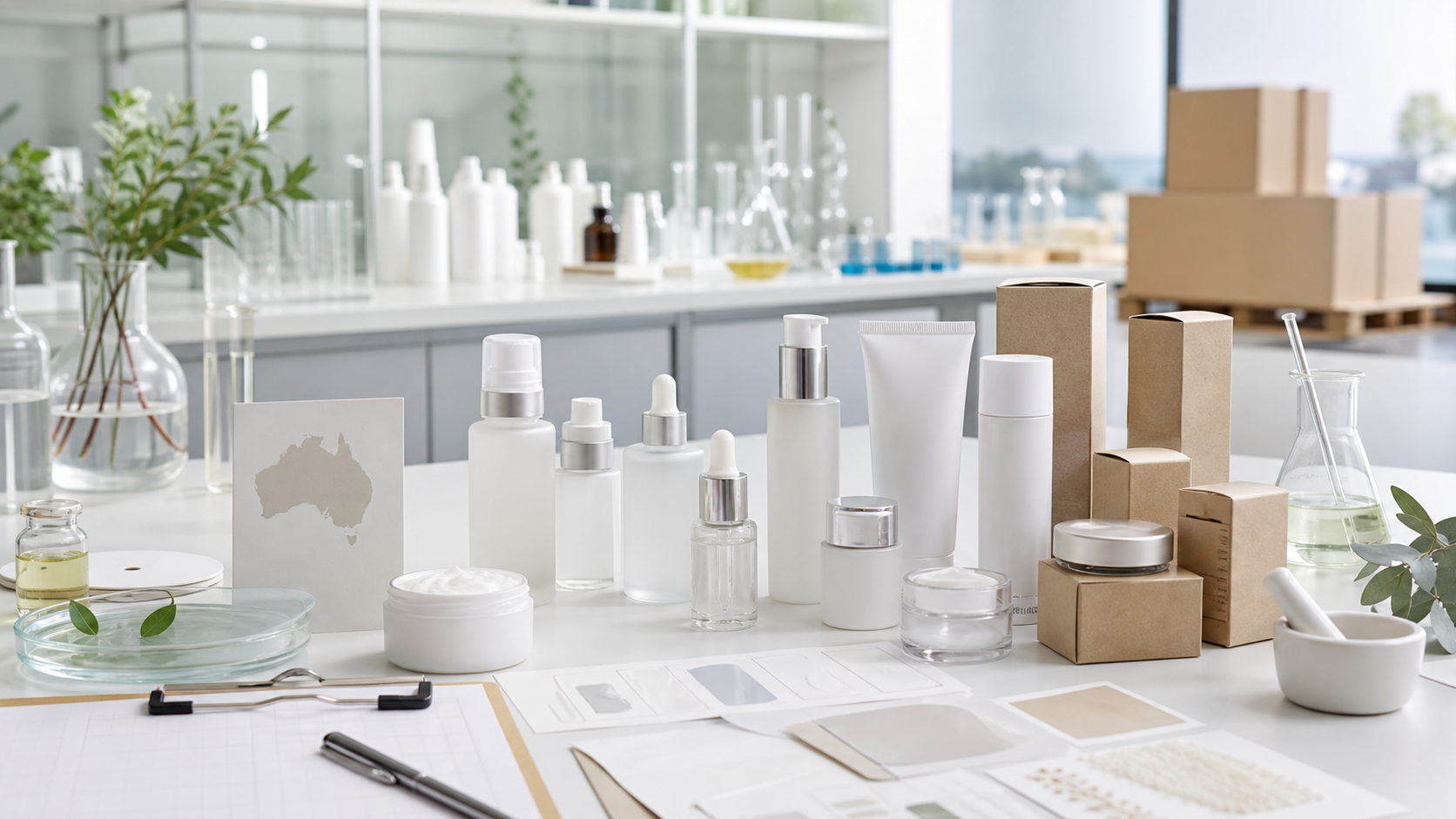
Australian beauty brands can work with a China cosmetic manufacturer by preparing a clear product brief, confirming local market responsibilities, testing samples carefully, and aligning packaging, quality control, and export documents before mass production. A factory can support formula development, private label skincare, packaging sourcing, sample development, production, and shipment preparation, while the Australian brand or importer remains responsible for checking applicable Australian requirements.
In practical terms, this cooperation is a structured B2B sourcing project. The brand defines the product, claim direction, packaging, launch channel, and compliance expectations; the cosmetic OEM manufacturer or cosmetic ODM manufacturer turns those inputs into samples, artwork checks, production plans, QC records, and export support.
Quick Summary
- Australian beauty brands should prepare a product brief, target price, packaging direction, claim limits, SKU plan, and launch timeline before requesting samples.
- A China cosmetic manufacturer can support stock formulas, custom formulation, packaging sourcing, sample development, mass production, quality control, and export support.
- Compliance responsibilities vary by product and target market; Australian importers should check ingredient, labelling, claim, and product classification requirements before selling.
- The best projects use written approvals for formula, fragrance, texture, packaging, artwork, QC standards, and shipping documents before production starts.
Why Australian Brands Source Cosmetic Manufacturing in China
Australia has a strong beauty market with demand for skincare, body care, hair care, color cosmetics, professional spa products, and DTC private label ranges. Many Australian founders, Amazon sellers, Shopify brands, distributors, salon groups, and clinic-adjacent brands look to China because they need flexible product development, broad packaging access, competitive manufacturing options, and export experience.
The benefit is not only cost. A capable partner can help a buyer compare private label skincare routes, adjust texture for the local climate, source packaging that suits e-commerce shipping, prepare retail-ready cartons, and plan repeat orders. For buyers who want more differentiation, custom formulation support can turn a concept into a more specific texture, ingredient story, fragrance direction, or product format.
The risk is that a vague brief can lead to the wrong sample, unsuitable claims, packaging delays, or a product that is difficult to register, label, ship, or sell. Australian brands should treat OEM/ODM cooperation as a project management process, not only a quotation request.
What Australian Buyers Should Prepare First
A clear brief helps the factory respond faster and reduces unnecessary sample rounds. The brief does not need to be perfect, but it should explain the product type, target customer, market channel, benchmark texture, preferred ingredients, claim direction, packaging concept, estimated order quantity, and launch date.
For a private label project, the buyer may start from an existing formula library and focus on packaging, fragrance, texture adjustment, label design, and MOQ. For a more differentiated brand, the buyer may choose a modified formula or full custom formulation. In both routes, the factory needs enough information to judge feasibility, sample cost, packaging lead time, filling method, stability review, and mass production schedule.
Useful Brief Inputs
- Product format: serum, moisturizer, cleanser, toner, sunscreen-adjacent cosmetic, lip care, mask, body care, hair care, or color cosmetic.
- Target channel: Shopify/DTC, Amazon, salon/spa, distributor, retail chain, clinic beauty retail, or subscription box.
- Formula route: stock formula, adjusted stock formula, or custom formulation.
- Packaging direction: bottle, jar, tube, airless pump, sachet, set box, refill pack, or travel kit.
- Claim boundaries: cosmetic appearance claims only, with no medical treatment promise or guaranteed regulatory approval.
How the OEM/ODM Workflow Usually Works
A reliable OEM/ODM service workflow begins with the buyer brief and ends with finished goods prepared for export. The process normally includes formula route selection, sample development, packaging matching, quotation, artwork review, pre-production approval, bulk manufacturing, filling, packing, quality control, and logistics coordination.
| Project Area | Australian Brand Responsibility | China Manufacturer Support |
|---|---|---|
| Product concept | Define target customer, claims, channel, benchmark, price range, and launch timing. | Recommend formula route, sample plan, MOQ, and technical feasibility. |
| Formula and samples | Review texture, fragrance, appearance, skin feel, and claim fit before approval. | Develop samples, adjust formula details, record revisions, and prepare approved standards. |
| Packaging | Choose pack format, decoration, label language, carton needs, and e-commerce protection. | Provide packaging sourcing and customization, compatibility checks, and filling advice. |
| Quality and documents | Confirm required documents with local advisors and define acceptance standards. | Support QC checks, batch records, retained samples, and export document coordination. |
Australian Compliance and Claims Planning
Compliance should be discussed early because requirements vary by target market, product type, ingredients, label, channel, and claims. For Australia, buyers commonly review ingredient obligations, cosmetic versus therapeutic product classification, mandatory ingredient labelling, responsible importer duties, and any special rules for products such as sunscreen, antibacterial items, or products making therapeutic-style claims.
Official Australian guidance is useful for orientation. AICIS explains cosmetics and industrial chemical obligations for importers and manufacturers; ACCC Product Safety provides information on cosmetic ingredient labelling; TGA guidance helps businesses consider whether a product may be a cosmetic or therapeutic good based on claims, ingredients, use, and presentation. These sources do not replace professional advice for a specific product.
From a manufacturing perspective, the buyer should avoid disease, treatment, cure, prevention, or drug-like performance claims unless qualified regulatory advice confirms the correct pathway. Safer cosmetic language usually focuses on cleansing, moisturizing, conditioning, improving appearance, helping skin feel comfortable, preparing makeup, or supporting a cosmetic routine. A factory can help keep formulation and documents organized, but it cannot guarantee approval or market acceptance.
Packaging, Climate, and Export Considerations
Australia-bound products may travel through long supply chains, warehouse storage, courier networks, and warm seasonal conditions. Packaging decisions should therefore consider leakage, cap torque, pump performance, carton strength, label durability, and compatibility between formula and container. A lightweight bottle may reduce shipping cost, but it still needs to protect the formula and survive distribution.
For DTC sellers, packaging also affects unboxing, return rates, and customer reviews. For distributors, carton size, barcode placement, shelf appearance, and reorder labels may matter more. For salons and spas, professional pack sizes, tester units, and back-bar products may be required. Mooyam can support private label skincare programs with packaging selection, decoration options, sample packs, and production planning.
Buyer Checklist Before Placing an OEM/ODM Order
Procurement Checklist
- Confirm the product route: stock formula, modified formula, or custom formulation.
- Prepare target formula notes, benchmark products, fragrance direction, texture preference, and restricted ingredients.
- Review Australia-related ingredient, label, and claim responsibilities with qualified local support.
- Approve final sample, color, fragrance, texture, packaging, artwork, label, carton, and fill volume in writing.
- Ask for packaging compatibility review, stability observations, microbial checks where relevant, and batch QC standards.
- Confirm MOQ, payment terms, production lead time, packaging lead time, inspection timing, and shipment handover terms.
- Keep a revision log for formula changes, packaging changes, artwork updates, and final production approvals.
Common Mistakes to Avoid
The first mistake is requesting a price before defining the product. A low price is not useful if the formula, packaging, fill weight, decoration method, carton, testing scope, and order quantity are unclear. The second mistake is approving a sample but changing packaging or claims later, which can trigger new compatibility checks, artwork updates, or production delays.
The third mistake is assuming that overseas factory documents automatically make a product ready for sale in Australia. Importers and brands should check local responsibilities before launch. The fourth mistake is forgetting reorders. Australian buyers should discuss reorder MOQ, packaging stock, fragrance continuity, lead time, and forecast planning before the first production run.
How Mooyam Cosmetic Supports Australian Beauty Projects
Mooyam Cosmetic supports overseas B2B buyers with OEM/ODM skincare and cosmetic manufacturing, including formula selection, sample development, packaging sourcing, mass production, quality control, and export support. For Australian brands, we can help structure the brief, compare formula routes, create samples, coordinate packaging, prepare production records, and support shipment planning.
For quality and compliance questions, buyers can review our quality control and compliance FAQ and share any market-specific requirements before sampling. Early communication helps the project team avoid unsuitable claims, mismatched packaging, incomplete artwork, and avoidable production delays.
Develop Cosmetics for the Australian Market with Mooyam
Looking for a reliable cosmetic OEM/ODM manufacturer in China? Contact Mooyam Cosmetic to discuss your product idea, formula requirements, packaging options, MOQ, sample development, and production plan. We support B2B brand manufacturing projects and do not accept retail orders.
FAQ
Can Australian brands use private label formulas from a China factory?
Yes. Many Australian startups and DTC sellers begin with private label skincare or cosmetic formulas, then customize fragrance, texture, packaging, artwork, and product story. The brand should still review local ingredient, labelling, and claim responsibilities before selling.
What information should I send before asking for a quotation?
Send the product type, formula route, benchmark, target texture, packaging preference, estimated quantity, market channel, claim direction, target price, and expected launch date. This helps the factory quote more accurately.
Can Mooyam help with custom formulation?
Yes. Mooyam can support custom formulation when a buyer needs a specific texture, ingredient direction, sensory profile, or product format. Custom work usually needs more sample rounds and a longer development timeline than stock formulas.
Who is responsible for Australian cosmetic compliance?
The Australian importer, supplier, or brand owner should confirm local requirements for the specific product. A manufacturer can provide technical information, production records, QC support, and export documents, but requirements vary and should be checked locally.
How many samples should a brand approve before mass production?
At minimum, approve the final formula sample in the intended packaging or a confirmed equivalent. For multi-SKU ranges, keep approved standards for each SKU, including texture, fragrance, color, fill level, packaging, and artwork.
Can packaging be sourced in China for Australian e-commerce brands?
Yes. Packaging sourcing can include bottles, jars, tubes, airless pumps, cartons, labels, boxes, and kits. For e-commerce, buyers should pay attention to leakage resistance, carton strength, product protection, and shipment handling.
Does working with a China cosmetic ODM manufacturer reduce launch time?
It can reduce development time when the buyer uses an existing formula library and makes decisions quickly. Timelines still depend on formula changes, packaging lead time, artwork approval, testing needs, production scheduling, and export logistics.
Official Reference Sources
- AICIS guidance on personal care, skincare, make-up and cosmetic products was reviewed for importer/manufacturer orientation.
- ACCC Product Safety cosmetic ingredients labelling mandatory standard was reviewed for general labelling awareness.
- TGA guidance on determining whether a product is a cosmetic or therapeutic good was reviewed for claim and classification awareness.
- These sources were used for general compliance background only. The article is original B2B manufacturing guidance and does not provide legal or regulatory approval advice.