Clay masks remain a practical product category for skincare brands because they are easy for customers to understand, visually distinctive, and flexible across oily-skin, pore-care, spa, clean-beauty, and self-care positioning. For B2B buyers, however, a successful clay mask is not only a nice texture in a jar. It must be manufacturable, stable, comfortable, compatible with packaging, and supported by realistic claims for the target market.
This guide explains how to launch a clay mask product with a cosmetic OEM/ODM factory, from concept brief and formula sampling to packaging sourcing, quality control, and bulk production. Mooyam Cosmetic supports brand and wholesale OEM/ODM projects; we do not accept retail orders.
Quick Summary
- Best-fit buyers: skincare startups, spa brands, DTC sellers, distributors, and private label skincare buyers planning a wash-off mask SKU.
- Main development work: clay selection, sensory feel, viscosity, drying profile, preservation, fragrance policy, color, and packaging compatibility.
- Key risk: treating a clay mask as a simple paste without checking stability, fillability, microbial control, leakage, and claim language.
- Mooyam support: custom formulation, sample development, packaging sourcing, low MOQ planning, quality control, and export support for B2B projects.
Why Clay Masks Still Work for Beauty Brands
A clay mask gives a brand strong shelf presence because the product texture, color, and application ritual are visible. It can sit in a simple private label skincare line, a spa-style range, a teen oily-skin collection, a clean-positioned assortment, or a premium treatment routine. The category also pairs well with cleansers, toners, serums, moisturizers, and facial tools.
From a manufacturing perspective, clay masks offer room for both private label and custom formulation routes. A brand may choose an existing base formula and customize color, scent, packaging, and label artwork. Another brand may ask a cosmetic ODM manufacturer to develop a new texture with a specific clay blend, botanical positioning, vegan direction, or premium sensory profile.
The important point is to keep the brief commercial and practical. Instead of asking for a mask that 鈥渄etoxes skin,鈥?buyers should describe target users, desired texture, rinse-off feel, drying time, product size, expected MOQ, sales channel, and target market. Claims and labels must be reviewed according to the rules of the destination market.
Choose the Right Clay Mask Concept
Clay mask projects often start with one of four product directions. Each route has different formula, cost, and packaging implications.
| Concept Type | Best For | Development Focus |
|---|---|---|
| Classic mineral clay mask | Entry-level private label skincare, Amazon, spa, or distributor programs. | Texture smoothness, drying comfort, rinse-off feel, color uniformity, and cost control. |
| Creamy clay treatment | Brands that want a less drying, more premium skin feel. | Emulsion stability, humectant balance, spreadability, preservation, and jar or tube compatibility. |
| Multi-clay or botanical mask | Natural-inspired brands and product story-led DTC launches. | Ingredient positioning, particle feel, fragrance policy, shade consistency, and claim discipline. |
| Powder-to-paste clay mask | Travel-friendly, waterless, or salon/spa formats. | Powder flow, moisture protection, usage instruction, filling, and packaging barrier performance. |
Formula Decisions That Affect the Final Product
Clay Blend and Texture
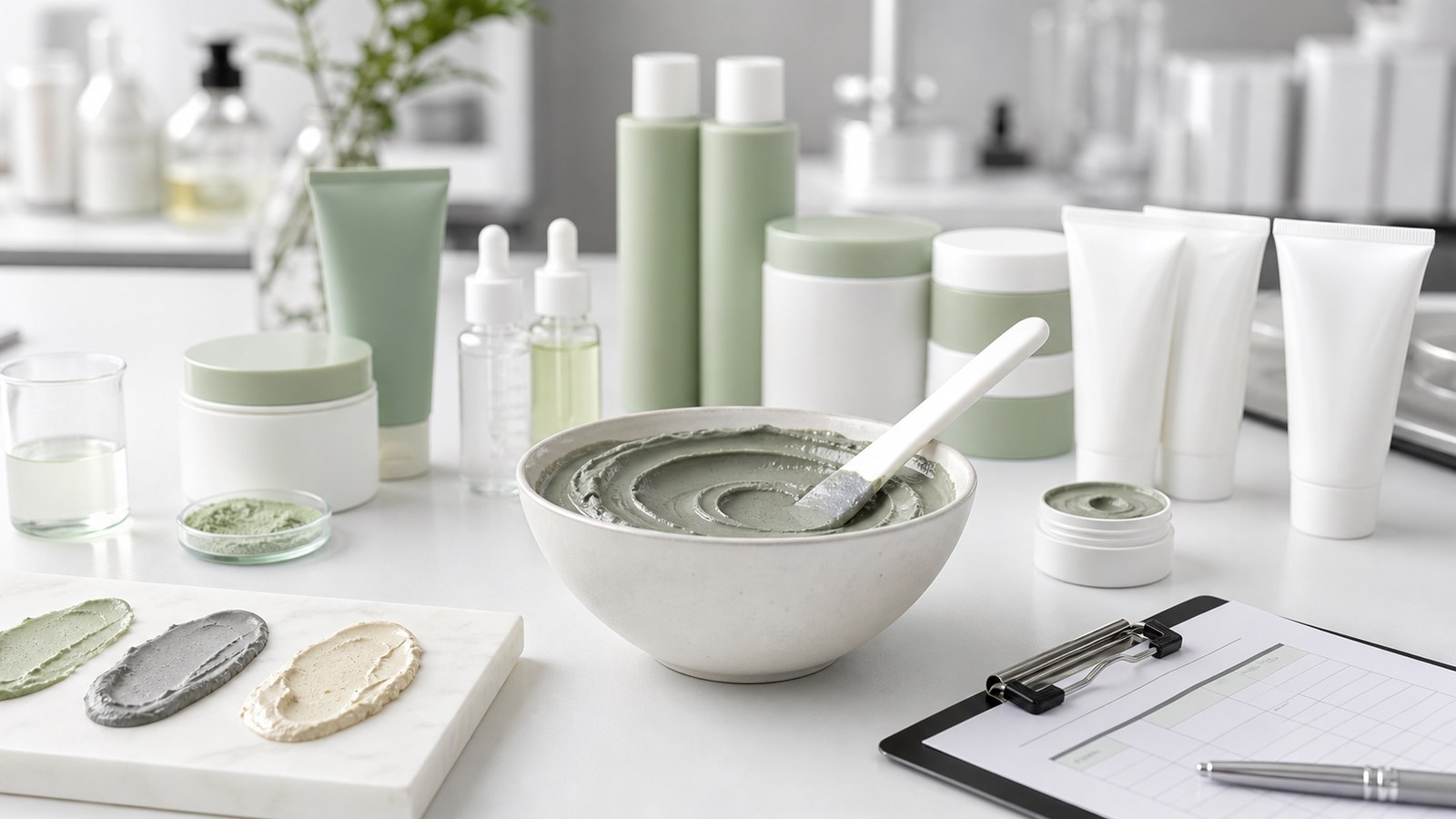
Kaolin, bentonite, illite, and other mineral materials can create different colors, absorbency, viscosity, and skin feel. The right blend depends on whether the brand wants a gentle creamy texture, a firmer oil-control mask, a colorful spa product, or a premium treatment feel. A cosmetic OEM manufacturer should test raw material quality, particle smoothness, color consistency, and how the clay behaves during mixing and filling.
Comfort and Drying Profile
Many buyers ask for strong cleansing language, but a mask that feels too tight or cracks quickly may reduce repeat purchase. A better product brief defines drying time, rinse-off feel, after-feel, and the level of visible clay performance. Humectants, emollients, polymers, and processing conditions can all change the final experience.
Preservation and Stability
Ready-to-use clay masks contain water and mineral materials, so preservation and microbial control need attention. Stability should consider viscosity drift, water separation, color change, odor, pH, packaging interaction, and transport temperature. Requirements may vary by target market, and buyers should avoid assuming one test package is enough for every region.
Packaging Sourcing for Clay Masks
Packaging is not only a branding decision. Clay masks can be heavy, abrasive, thick, or prone to drying at the opening if the component is poorly matched. Jars are common because they show texture and support thicker fills. Tubes may feel cleaner for consumers but require careful viscosity and filling trials. Sachets can work for samples, travel sizes, and spa use, but they need strong sealing and accurate fill weight control.
Mooyam Cosmetic can help compare component routes through its custom cosmetic packaging support, including jars, tubes, cartons, labels, decoration, and component MOQ. Packaging should be reviewed together with the formula before artwork and bulk production are approved.
| Packaging Option | Advantages | Watchpoints |
|---|---|---|
| Jar | Shows texture, supports thick formulas, common for spa positioning. | Hygiene communication, liner fit, leakage test, and carton protection. |
| Tube | Convenient, modern, and easier for repeated consumer use. | Formula must dispense cleanly; thick clay may require a wider orifice. |
| Sachet | Good for sampling, travel, and low-risk launch testing. | Seal strength, fill accuracy, drying risk, and minimum order quantity. |
OEM/ODM Development Process
A reliable clay mask project usually follows a clear path. First, the buyer shares a product brief, target market, benchmark references, ingredient preference, packaging idea, MOQ expectation, and target price. The factory then reviews feasibility and proposes a private label or custom formulation route.
During sample development, Mooyam Cosmetic can prepare texture samples, adjust color and scent, test packaging fit, and help buyers compare cost and lead time. Once a formula and component are approved, the team prepares production specifications, raw material checks, filling parameters, finished product criteria, and packing requirements. Buyers can learn more about the broader OEM/ODM manufacturing service and custom formulation support when planning a new mask project.
Buyer Checklist Before Sampling
- Define the exact mask type: ready-to-use cream clay, classic mineral clay, powder-to-paste, sachet, jar, or tube format.
- Prepare target users, price tier, sales region, launch quantity, and expected timeline.
- Decide whether the project should use a private label skincare base or a new custom formula.
- Confirm preferred clay color, fragrance direction, ingredient restrictions, vegan or natural-positioning needs, and claim limits.
- Ask for packaging compatibility, leakage, fillability, viscosity, pH, appearance, odor, and microbiological review where applicable.
- Discuss low MOQ, sample rounds, bulk production schedule, export support, and reorder planning before approving the first purchase order.
Quality Control Points
Clay masks need disciplined quality control because small changes in mineral raw materials or mixing conditions can affect color, spreadability, viscosity, and filling behavior. A professional supplier should set standards for appearance, odor, pH, viscosity, net content, packaging function, label placement, carton condition, and batch documentation. Review Mooyam Cosmetic’s quality control and compliance information when preparing your specification.
FAQ
Can Mooyam Cosmetic make private label clay masks?
Yes. Mooyam Cosmetic can support private label clay mask projects and custom OEM/ODM development depending on formula requirements, packaging, MOQ, and target market.
What is the best packaging for a clay mask?
Jars are common for thick textures, tubes are convenient for cleaner application, and sachets work for samples or travel sizes. The best option depends on viscosity, positioning, cost, and MOQ.
Can I request a custom color or botanical ingredient story?
Yes, but the request must be checked for formula stability, raw material availability, cost, labeling, and target-market claim rules.
How many sample rounds are usually needed?
Many projects need one to three rounds, depending on how clearly the buyer defines texture, color, fragrance, packaging, and benchmark expectations.
Can clay masks be produced with low MOQ?
Some private label or standard packaging routes may support lower starting quantities. Custom packaging, special ingredients, and decoration can increase MOQ.
What tests should buyers ask about?
Discuss stability, microbiological review where applicable, viscosity, pH, packaging leakage, fill weight, appearance, odor, and batch consistency.
Can one clay mask formula be sold in all markets?
Not automatically. Ingredient, label, claim, and documentation expectations can vary by destination market, so buyers should confirm requirements before launch.
Develop Clay Mask Products with Mooyam Cosmetic
Looking for a clay mask manufacturer for your skincare brand? Mooyam Cosmetic can support cosmetic OEM manufacturer and cosmetic ODM manufacturer projects with private label skincare selection, custom formulation, packaging sourcing, sample development, low MOQ planning, bulk production, quality control, and export support. Contact us to discuss your formula idea, packaging options, MOQ, target market, and production plan.