
Cream eyeshadow sticks are gaining renewed attention because buyers want eye products that are portable, fast to apply, and easy to merchandise in shade families. For beauty brands, the opportunity is not simply another eye color SKU; it is a format that needs disciplined formula, packaging, stability, and compliance planning.
This guide explains how Mooyam Cosmetic supports cream eyeshadow stick OEM/ODM projects for brand owners, importers, and beauty distributors. Mooyam Cosmetic is a cosmetics and makeup OEM/ODM factory, and we do not accept retail orders.
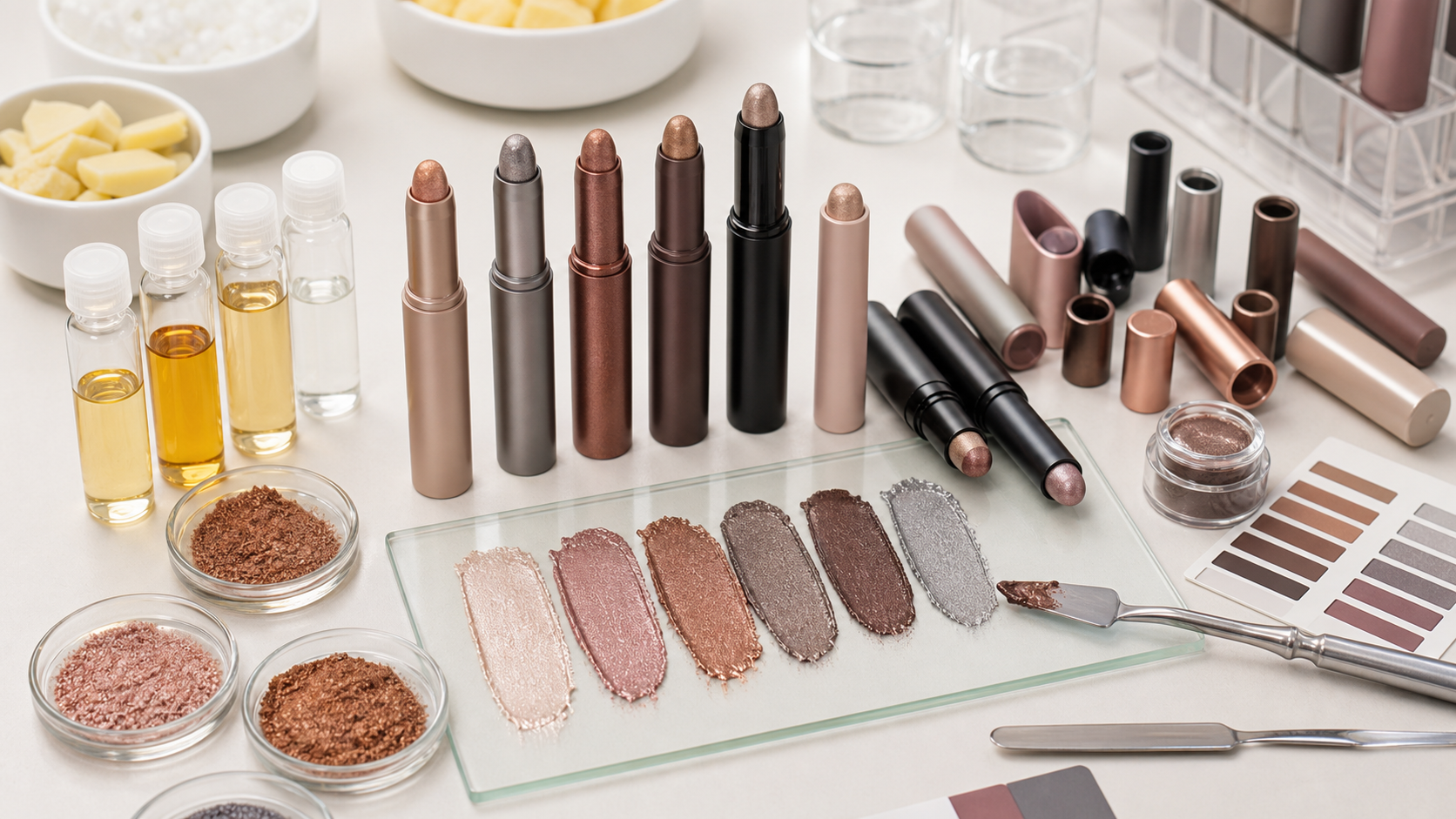
- Cream eyeshadow sticks work best when the brief defines glide, play time, dry-down, payoff, crease resistance, and removal expectations before sampling.
- Eye-area formulas require careful pigment and color additive review, especially for markets that restrict certain shades around the eyes.
- Packaging should be selected with formula hardness, fill process, cap fit, twist mechanism, and transport temperature in mind.
- Mooyam Cosmetic can help B2B buyers develop shade ranges, benchmark textures, produce samples, test stability, and prepare bulk production for private label or OEM/ODM orders.
Why Cream Eyeshadow Sticks Fit 2026 Eye Makeup Demand
Recent eye makeup coverage points to stronger color stories, smudged finishes, metallic accents, and fast application formats. A stick format lets brands translate those trends into an easy SKU: consumers can swipe, blend, layer, and travel with it without a separate brush. For B2B buyers, the format also supports clear merchandising options such as starter trios, seasonal metallic sets, matte contour shades, or highlight tones where local regulation allows the claim.
The OEM/ODM decision should begin with the use case. A stick for a clean matte office look is different from a high-shine festival metallic, and both are different from a soft-focus base shade. If the brief only says long-wear cream eyeshadow stick, the supplier may create a technically acceptable sample that still misses the brand positioning. A stronger brief defines finish, target customer, geography, claims, application method, and price band.
Formula Strategy: Balance Glide, Payoff, and Wear
Texture Architecture
A cream eyeshadow stick usually depends on a wax, oil, emollient, film-former, powder, and pigment balance. More wax can improve stick integrity but may reduce glide. More volatile or lightweight emollient can improve slip and dry-down but may create shrinkage or sweating during stability testing. Higher pearl or pigment loading can improve visual impact but may affect payoff uniformity, drag, and breakage.
Mooyam Cosmetic typically recommends sampling three formula directions before locking a project: soft-glide shimmer, cream-to-powder satin, and higher-wax matte. This lets buyers compare feel and packaging compatibility before approval.
Shade and Pigment Planning
Eye makeup shade planning needs more than attractive color cards. A practical OEM/ODM range should separate daily neutrals, trend colors, deep liner shades, and highlight pearls. Buyers should also confirm whether the intended shades are suitable for the eye area in target markets. Color additive rules are not identical across regions, so the formula and claim review should happen before package artwork or sales materials are finalized.
| Development Choice | Buyer Decision | OEM/ODM Checkpoint |
|---|---|---|
| Matte neutral stick | Soft contour, base shade, or crease color | Drag, patchiness, payoff after blending, breakage resistance |
| Satin everyday shimmer | Core SKU for broad age and skin tone appeal | Pearl dispersion, crease resistance, cap seal, surface sweating |
| Metallic trend shade | Limited edition, holiday set, creator-led color story | Pearl size, eye-area suitability, fallout, texture roughness |
| Deep liner shade | Smudged liner or smoky eye positioning | Transfer, sharpening need, pigment compliance, removal feel |
Packaging: The Stick Mechanism Is Part of the Formula
Buyers often treat the component as a visual decision, but stick packaging is a technical decision. A formula that performs in a lab mold can fail in a twist-up barrel if the diameter, cup depth, filling method, cooling rate, or cap seal is not aligned. The wrong component may cause leaning, bullet drop, cap contamination, or rough twist movement after transport.
For OEM/ODM work, Mooyam Cosmetic can help buyers evaluate stock components and decoration options such as matte shell, metallic shell, color-matched cap, carton, blister, or set box. For most first launches, a proven stock mechanism with custom color and printed outer packaging is more predictable than an untested custom mold. Custom tooling can be considered after the shade range and repeat order forecast are more stable.
Recommended OEM/ODM Development Flow
| Stage | What the Buyer Provides | Factory Output |
|---|---|---|
| 1. Product brief | Target market, shade direction, finish, benchmark, claim limits | Formula route, packaging suggestions, estimated MOQ and timeline |
| 2. Lab sampling | Feedback on glide, payoff, dry-down, shade and scent preference | Adjusted samples and shade drawdowns for approval |
| 3. Compatibility and stability | Selected component and intended logistics markets | Heat, freeze-thaw, leakage, twist, surface and bulk checks |
| 4. Pre-production | Artwork, INCI review, carton copy, approved master shade | Pilot batch, color standard, packaging confirmation |
| 5. Mass production | Purchase order, shipping plan, inspection requirement | Bulk production, QC records, packing and shipment support |
Buyer Checklist Before Requesting Samples
- Define whether the stick should be matte, satin, pearl, metallic, glitter-free, waterproof, transfer-resistant, vegan, fragrance-free, or sensitive-eye positioned.
- List target markets so pigment and eye-area suitability can be reviewed early.
- Provide two to three benchmark products for texture direction, not for copying formula or packaging design.
- Confirm shade count, launch sets, expected price tier, and whether refill or mini formats are needed.
- Decide whether the first order should use stock packaging, semi-custom decoration, or a custom component.
- Ask for stability, compatibility, micro, heavy metal, and production QC expectations before confirming the final sample.
Claims and Quality Control for Eye-Area Products
Eye products require cautious claim language. Words such as ophthalmologist tested, safe for waterline, hypoallergenic, or clean should not be used unless the brand has documentation that supports the specific statement in the intended market. A safer B2B approach is to build around measurable checks: application feel, break strength, odor, appearance, color consistency, microbial limits, heavy metal screening where relevant, and packaging function after heat exposure.
Mooyam Cosmetic can support sample iteration, technical documentation, ingredient list preparation, shade standard control, bulk filling checks, and final inspection coordination for repeatable wholesale and distributor orders.
If your brand is planning a cream eyeshadow stick range, send Mooyam Cosmetic your target market, finish direction, shade count, benchmark texture, packaging preference, and expected launch timing. Our team can review the brief and suggest a practical sampling path for private label, OEM, or ODM production. Mooyam Cosmetic works with B2B cosmetics and makeup brands only and does not accept retail orders.
FAQ
What MOQ is typical for cream eyeshadow stick OEM/ODM projects?
MOQ depends on formula complexity, shade count, component availability, decoration method, and filling process. Stock packaging with standard decoration usually gives buyers a more flexible starting point than a fully custom component.
Can one formula support both matte and shimmer shades?
Sometimes, but not always. Pearl loading, pigment type, wax level, and desired payoff may require formula adjustments by shade family. Testing each approved shade is important because texture and stability can shift with pigment load.
How long does sampling take?
A basic sample round can be faster when the buyer provides a clear brief and benchmark. More complex claims, custom packaging, or large shade ranges require extra time for color matching, stability, and compatibility review.
Can Mooyam Cosmetic copy a trending retail product?
No. Mooyam Cosmetic can use benchmarks to understand texture direction and market positioning, but the formula, shade plan, packaging recommendation, and article content must be developed as original OEM/ODM work.
Are all pigments suitable for eye makeup?
No. Pigment and color additive suitability depends on target market rules and the intended eye-area claim. Buyers should confirm compliance direction before approving final shades or packaging text.
The following links are included for trend, SEO direction, compliance, and industry background only. This article is original B2B OEM/ODM procurement guidance created for beauty brand buyers and is not copied, translated, or structured from the source pages.