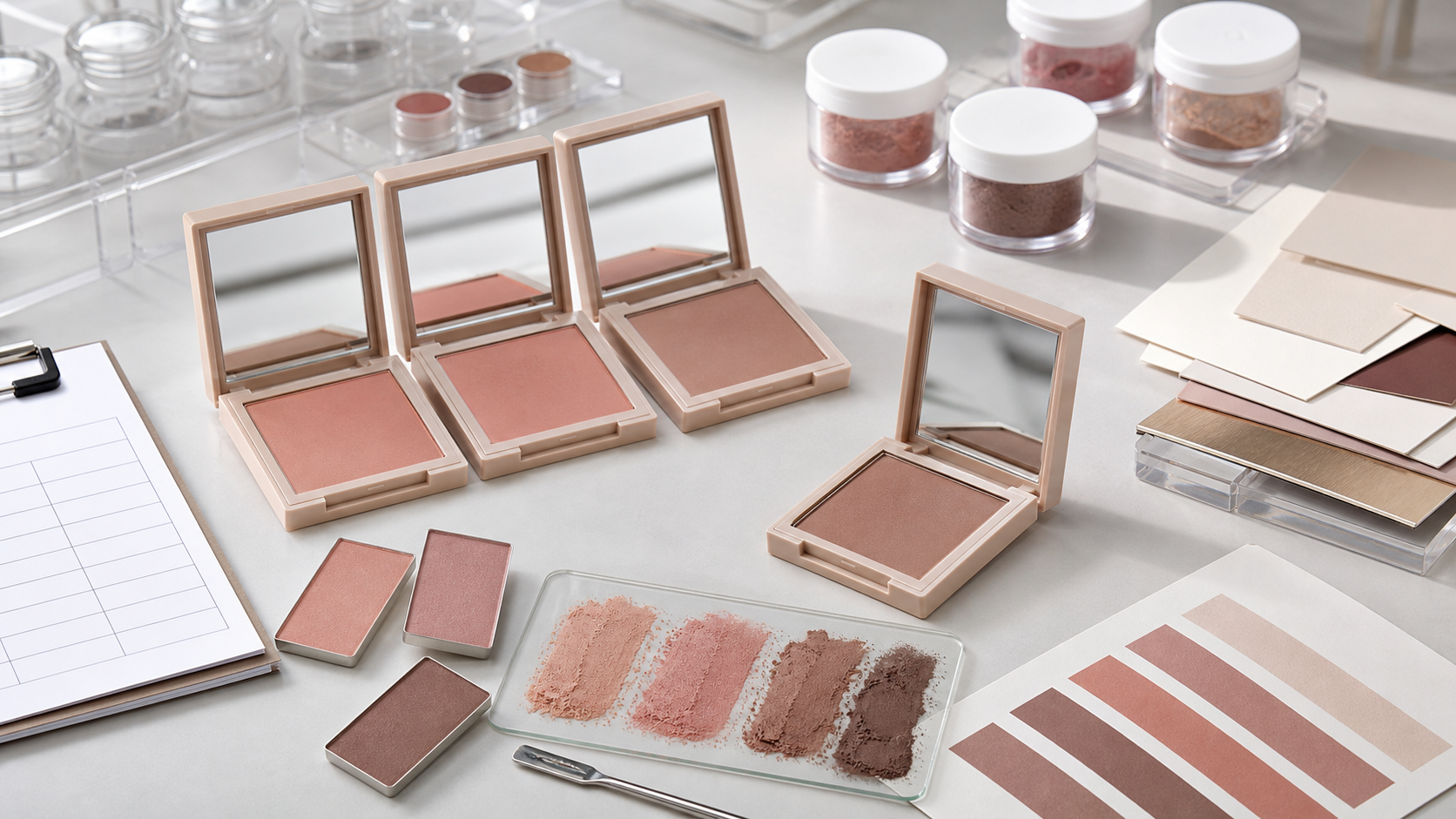
Nude blush is moving beyond one universal beige. For beauty brands, the commercial opportunity is to build a soft, wearable cheek range that still has enough undertone logic, texture control and packaging discipline to feel intentional across markets.
This guide explains how Mooyam Cosmetic can help brands develop nude blush compacts through OEM/ODM manufacturing, from shade mapping and formula texture to refill pan decisions, stability checks and launch documentation. Mooyam Cosmetic is a cosmetics and makeup OEM/ODM factory; we support brand production projects and do not accept retail orders.
Quick Summary
- Nude blush compacts work best when shades are planned by undertone, depth and finish rather than by simple light-to-dark naming.
- OEM/ODM development should define whether the compact is pressed powder, cream-to-powder, baked powder or refillable pan before packaging is selected.
- For B2B buyers, the critical checks are color payoff, hard-pan risk, drop resistance, mirror/pan fit, shade consistency and label-ready ingredient documentation.
- Mooyam Cosmetic supports sampling, shade matching, packaging sourcing, MOQ planning, QC testing and production.
Why Nude Blush Compacts Fit 2026 Beauty Buying
Recent makeup trend coverage points to softer neutral cheek colors and wearable finish preferences. For a brand buyer, the opportunity is a core cheek line that can be merchandised clearly and adapted to different skin tones without overextending inventory.
A nude blush compact also gives brands a manufacturing advantage. Neutral shades can work as daily makeup, gift-set components and core SKU extensions, while compact or refill formats create clearer shelf presentation than loose products.
Define the Product Architecture Before Sampling
Many blush projects start with shade references, but factories need a sharper brief. First define the physical product type: pressed powder, cream-to-powder, baked powder or refill pan. Each route affects filling, pressing, stability and packaging cost.
| Compact type | Best for | OEM/ODM focus |
|---|---|---|
| Pressed powder blush | Classic retail lines, broad shade ranges, matte or satin finishes | Powder binding, payoff, pan adhesion, drop resistance and surface smoothness |
| Cream-to-powder compact | Skin-like finish, finger application, dry-touch claims | Emollient balance, sweat resistance, pay-off after storage and compatibility with plastic components |
| Refillable blush pan | Eco-positioned brands, pro palettes and repeat-purchase programs | Pan dimensions, magnet fit, refill protection, secondary packaging and assembly tolerance |
| Baked blush | Radiant nude shades and premium texture stories | Baking process control, dome shape, shimmer dispersion and shade consistency |
Build a Nude Shade System, Not Random Beige Shades
A strong nude blush line needs a shade map. Brands should decide whether the range will cover fair, light-medium, tan, deep and rich skin tones, or target one market segment with fewer shades. Mooyam Cosmetic recommends planning by undertone first: peach beige, rose beige, mauve nude, terracotta nude, cocoa nude and muted berry brown can cover different complexion needs without looking repetitive.
Undertone and depth decisions
The mistake is assuming that nude means pale. A nude blush for deeper skin can be toasted rose, soft brick, mocha or muted plum. During OEM/ODM sampling, brands should request pressed-pan samples and face-swatch references under consistent lighting.
Finish and sensory positioning
Finish changes the consumer promise. Soft matte supports blurred makeup, satin feels more skin-like, and pearl can look premium when particle size is controlled. In humid markets, dry-touch finish and transfer resistance may matter more than shine.
Formula Development Priorities for Nude Blush
Nude blush is unforgiving because dullness, gray cast and patchiness show quickly. The formula must balance slip, adhesion and buildability so one layer looks natural and a second layer still adds clean color.
For pressed powder, Mooyam Cosmetic checks powder feel, binder level, surface hardness, brush pickup, pan adhesion and breakage resistance. For cream-to-powder compacts, the lab focuses on oil phase balance, wax structure, payoff after temperature cycling and compatibility with the case gasket. For refillable pans, the pan material and adhesive or magnet system must be validated early, not after shade approval.
Packaging Choices That Affect Cost and Quality
The compact is not only decoration. It controls user experience, transit risk and perceived value. Case shape, mirror, closure and refill design all affect mold cost, MOQ, lead time and assembly risk.
| Development stage | Buyer decision | Mooyam support |
|---|---|---|
| Concept brief | Target market, finish, shade count, compact style and price band | Formula route, packaging options and preliminary MOQ discussion |
| Lab sampling | Approve base texture, shade direction and payoff level | Pilot samples, shade corrections and performance feedback |
| Packaging validation | Confirm pan size, mirror, closure, refill or non-refill design | Fit test, filling test, drop check and assembly review |
| Pre-production | Approve bulk standard, artwork and shipment plan | QC standard, retained sample and batch production control |
Quality Control and Stability Tests Buyers Should Request
Before mass production, buyers should request shade consistency checks, surface inspection, drop or vibration checks, packaging compatibility, accelerated storage and usability testing. Powder formulas need hard-pan review; cream formulas need sweating, shrinkage and oil separation review.
- Confirm the approved bulk standard and pan sample under consistent lighting.
- Check color payoff on at least three skin depth references, not only on white paper.
- Review ingredient list, color additive status and market-specific label requirements before printing packaging.
- Validate mirror clarity, hinge strength, closure feel and pan fit before approving compact tooling or stock packaging.
- Ask for retained samples from pre-production and mass production for future comparison.
- Define acceptable color tolerance, broken-pan tolerance and packaging defect limits in the purchase order.
MOQ, Sampling and Production Planning
MOQ depends on formula type, pan size, packaging source, shade count and whether the brand uses stock or custom packaging. For emerging brands, Mooyam Cosmetic can discuss lower-risk structures such as one hero shade plus two support shades before moving into exclusive molds.
A practical timeline includes brief, first sample, shade correction, packaging selection, stability checks, artwork confirmation, pre-production sample, bulk production, filling, packing and shipment. Clear benchmarks reduce sampling rounds.
Work with Mooyam Cosmetic on Nude Blush Compacts
Mooyam Cosmetic supports cosmetics and makeup OEM/ODM projects for brands, importers and distributors. For nude blush compacts, our team can help with formula sampling, shade matching, compact sourcing, QC and production. We do not accept retail orders; please contact us for B2B cooperation via the Mooyam Cosmetic contact page.
FAQ
Can Mooyam Cosmetic create a custom nude blush shade range?
Yes. Mooyam can support custom shade development based on benchmark samples, target undertones, market positioning and approved ingredient restrictions. A clear shade map helps reduce unnecessary sampling rounds.
Is pressed powder or cream-to-powder better for a nude blush compact?
Pressed powder is usually better for classic compact lines and wider shade ranges. Cream-to-powder is useful when the brand wants a smoother skin-like payoff, but it requires stronger compatibility and temperature checks.
Can the compact be refillable?
Yes, refillable formats are possible when the pan size, magnet or locking system, outer compact and secondary packaging are designed together. Refill claims should match the real packaging structure.
What should buyers prepare before asking for a quote?
Prepare target market, formula type, finish, shade count, compact preference, expected order quantity, benchmark products and any restricted ingredients or compliance requirements. This makes the quotation more accurate.
Trend Reference / Sources
These links are used only as trend, SEO direction, regulatory or industry background references. The article above is original B2B OEM/ODM procurement guidance for cosmetics and makeup brands and does not copy, translate or follow the structure of the source material.
- Google Search Central helpful content guidance was used to keep the article focused on useful buyer decisions instead of keyword stuffing.
- Who What Wear nude blush trend coverage and 2026 makeup trend coverage were reviewed as directional market background for soft neutral cheek colors and wearable finish preferences.
- FDA Cosmetics Labeling Guide was used as a regulatory background reference for label planning.
- FDA color additives permitted for cosmetics was reviewed as a background reference because blush compact shades depend on approved colorant choices.