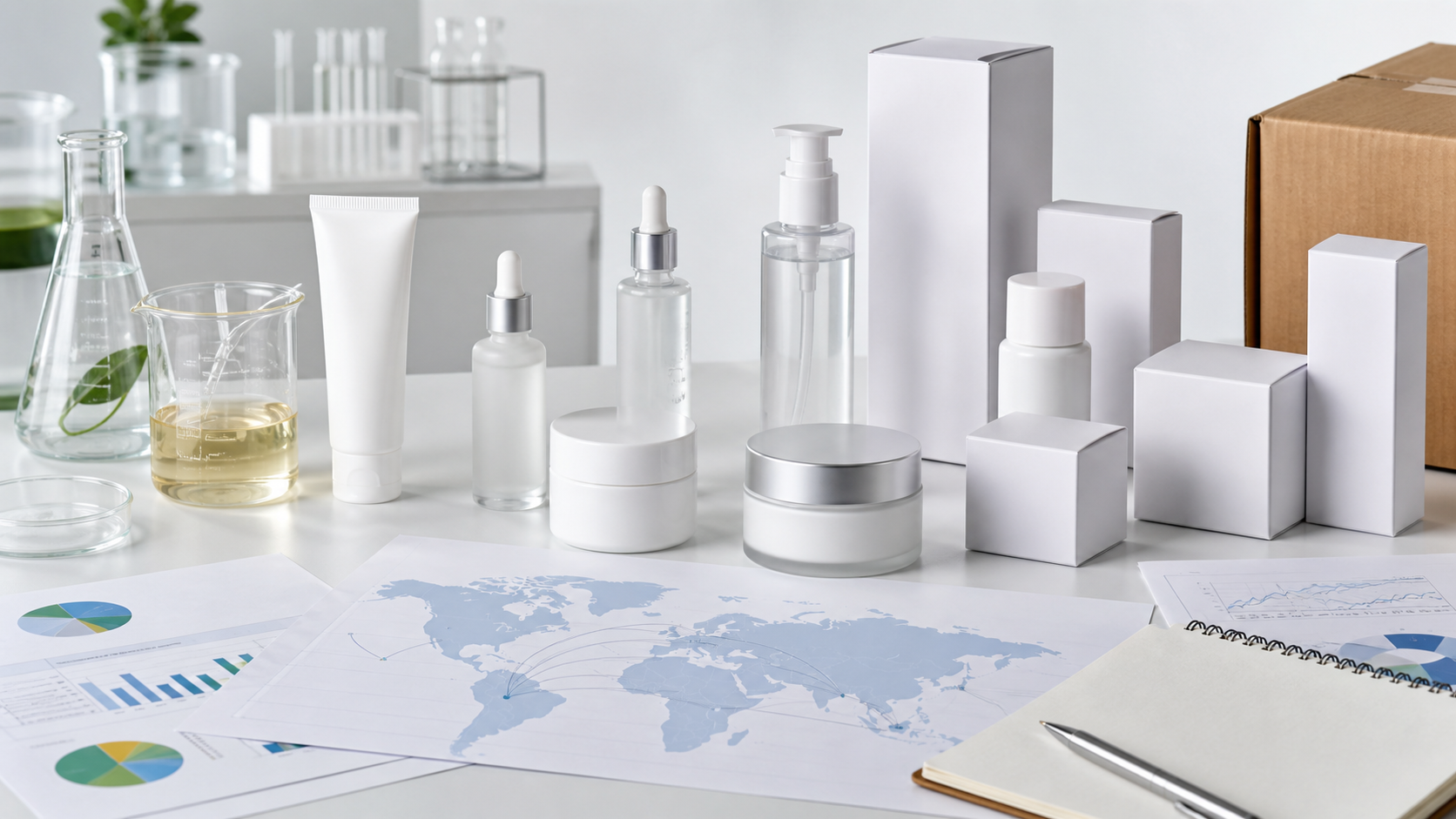
Selling cosmetics in different markets can create strong growth for beauty brands, but it also makes product planning more complex. A formula, label, claim, package, document set, and shipment plan that work for one country may need adjustment before the same product can be sold elsewhere.
This guide is written for overseas beauty brands, Amazon and DTC sellers, distributors, and private label buyers planning cross-border cosmetic projects with Mooyam Cosmetic. We support B2B OEM/ODM projects, including private label skincare, custom formulation, packaging sourcing, sample development, bulk production, quality control, and export support. We do not accept retail orders.
- Different sales markets may require different label language, ingredient review, claims control, importer documents, and packaging details.
- Brands should define target countries before formula sampling, not after artwork and production are finished.
- A cosmetic OEM manufacturer can help with product information, packaging coordination, QC records, and export support, but final market requirements should be checked locally.
- Mooyam Cosmetic helps B2B buyers connect formula, packaging, sample approval, low MOQ planning, bulk production, and market-aware project management.
Why Market Planning Should Start Before Sampling
Many new brands begin with a simple product idea: a serum, cream, cleanser, body care item, or makeup SKU. The problem appears later, when the buyer decides to sell the same product across several markets and discovers that the artwork, claims, language, ingredient expectations, responsible party details, or import documents are not ready.
For international buyers, the safer approach is to discuss target markets during the first product brief. This allows the cosmetic ODM manufacturer to review whether the formula route, packaging choice, MOQ, sample development timeline, and testing plan are suitable for the buyer’s sales regions. Requirements can vary by country or region, so no factory should promise universal approval without reviewing the specific case.
Key Market Factors Beauty Brands Should Compare
Market differences do not always require a new formula, but they can affect project decisions. Ingredient restrictions, claim language, labeling format, barcode requirements, language versions, carton information, import documents, and platform rules can all change how a product should be prepared. A distributor may need more documentation than an Amazon seller, while a salon or spa channel may care more about professional-use instructions and carton protection.
| Planning Area | Buyer Question | OEM/ODM Project Impact |
|---|---|---|
| Formula and ingredients | Are all ingredients suitable for the target sales markets? | May affect custom formulation, ingredient substitution, fragrance policy, and sample approval. |
| Claims and positioning | Are claims cosmetic, realistic, and supported by the finished product? | May require softer wording, artwork revision, or local regulatory review before printing. |
| Label content | What languages, net content, INCI, warnings, usage directions, and responsible-party details are needed? | Changes label size, carton layout, artwork timing, and proof approval. |
| Packaging | Will the package survive the channel, climate, warehouse, and shipment route? | Affects bottle, tube, jar, pump, cap, carton, leakage testing, and export carton strength. |
| Documents | What product information, batch records, test summaries, or shipping documents may be requested? | Requires better coordination between R&D, production, QC, and export support teams. |
Formula and Ingredient Decisions
A formula should be developed with the sales market in mind. If the buyer wants fragrance-free private label skincare for sensitive-positioned channels, the factory should know that early. If the brand wants a brightening, anti-aging, acne, SPF, or treatment-style story, claim wording and ingredient expectations must be handled carefully because cosmetic and drug boundaries vary by market.
Mooyam Cosmetic can support custom formulation and private label formula selection based on product type, target cost, texture preference, packaging route, and market notes. For lower-risk launches, private label skincare options can shorten development time, but brands should still review whether the final formula and label direction fit their destination market.
Claims, Labeling, and Artwork Control
Claims are a common source of late project changes. A product page may say “repairs skin,” a carton may say “clinically proven,” or a label may imply medical treatment when the product is intended as an ordinary cosmetic. These issues can delay printing, import, marketplace review, or distributor onboarding.
Before artwork is approved, buyers should review product name, claim hierarchy, usage directions, caution statements, ingredient list, net content, batch code space, country of origin, barcode, responsible party information, and any market-specific language. Mooyam Cosmetic can help coordinate label and carton production through customized packaging support, but buyers should confirm final legal wording for each target market with qualified local advisors.
Quality Control and Export Support
When a product will be sold in several regions, quality control should be planned beyond appearance alone. Buyers should ask how the factory controls raw materials, formula batch records, filling weight, packaging function, label placement, carton condition, retained samples, and shipment preparation. The exact testing plan depends on formula type, packaging, claims, and importer expectations.
Mooyam Cosmetic’s quality control and compliance support helps buyers prepare practical project checkpoints before bulk production. Export support may include product information coordination, packing details, carton marks, shipment document preparation, and communication with the buyer’s freight or import team. This support is useful, but it does not replace the buyer’s responsibility to confirm local market rules.
Market Readiness Workflow
| Stage | Buyer Should Prepare | Mooyam Cosmetic Can Support |
|---|---|---|
| 1. Target market brief | Countries, channels, importer role, launch timeline, claim direction, and product category. | Project feasibility review, formula route, MOQ direction, and packaging planning. |
| 2. Sample development | Texture feedback, fragrance preference, benchmark samples, usage scenario, and target price. | Formula samples, sample revisions, packaging matching, and stability observations. |
| 3. Artwork planning | Label languages, INCI format, net content, warnings, barcode, carton copy, and responsible-party details. | Artwork size coordination, packaging sourcing, print proof review, and component samples. |
| 4. Production approval | Final sample, final artwork, order quantity, QC criteria, shipment method, and document needs. | Bulk production, filling, inspection, packing, retained samples, and export handoff. |
Buyer Checklist Before Selling Across Markets
- List every target country or region before requesting final samples.
- Decide whether one formula and one artwork version are realistic for all markets.
- Confirm ingredient restrictions, fragrance preferences, claim boundaries, and product category expectations.
- Prepare label language, net content format, barcode, batch code, importer information, and carton copy early.
- Check whether e-commerce, distributor, salon, spa, or retail channels need different packaging or documents.
- Ask for packaging compatibility, leakage, label adhesion, carton strength, filling weight, and retained sample controls.
- Discuss low MOQ launch quantities and reorder planning before ordering custom packaging.
- Use local regulatory review for final claims and labels where required.
Common Mistakes to Avoid
A frequent mistake is approving a formula and printing packaging before confirming the destination markets. Another is using aggressive online marketing claims that do not match the label or evidence. Some buyers also underestimate how packaging MOQ, carton size, label language, or import documents can affect launch timing.
Brands should also avoid assuming that a supplier’s export experience means the product can automatically be sold everywhere. A reliable cosmetic OEM manufacturer should help prepare practical information, but requirements vary by target market, and the brand or importer should confirm local obligations before sale.
Plan Multi-Market Cosmetic Projects with Mooyam
Looking for a reliable cosmetic OEM/ODM manufacturer for international beauty projects? Mooyam Cosmetic can support OEM/ODM service, private label skincare, custom formulation, packaging sourcing, sample development, low MOQ planning, bulk production, quality control, and export support. Contact us to discuss your target markets, formula requirements, packaging options, MOQ, and production solution. We work with brand and wholesale OEM/ODM buyers only, not retail orders.
FAQ
Can one cosmetic formula be sold in several countries?
Sometimes, but not automatically. Ingredient rules, labeling, claims, documentation, and responsible-party requirements can vary by market, so buyers should review the formula and artwork before launch.
Should target markets be confirmed before sample development?
Yes. Target markets can affect formula restrictions, fragrance policy, claim language, packaging, test expectations, and artwork layout.
Can Mooyam Cosmetic provide regulatory approval?
Mooyam Cosmetic can support product information, QC records, packaging coordination, and export preparation, but final market approval or registration responsibilities depend on the destination market and buyer/importer role.
What documents may buyers need for import?
Needs vary, but buyers may request product information, ingredient list, batch details, test summaries, packing information, invoices, and shipment documents depending on the market and channel.
Can private label skincare be adapted for different markets?
In many cases, yes. Adaptation may involve label language, claim wording, packaging choice, fragrance direction, or ingredient review rather than a completely new formula.
Does Mooyam Cosmetic handle retail orders?
No. Mooyam Cosmetic supports business buyers, beauty brands, distributors, private label teams, Amazon sellers, and wholesale OEM/ODM projects only.