
Milky toner has turned a familiar skincare step into a hybrid hydration format positioned between a watery toner and a lightweight emulsion. For beauty brands, the opportunity is attractive, but the product must remain uniform, pourable and comfortable throughout its shelf life.
This guide explains the decisions buyers should make before starting a milky toner OEM/ODM project with Mooyam Cosmetic. We manufacture for brands and distributors and do not accept retail orders.
Quick Summary
- Define whether the product should feel like a toner, essence or very light lotion.
- Build the milky appearance from a stable formulation system, not visual opacity alone.
- Select humectants, emollients and barrier-support ingredients around a realistic claim brief.
- Test separation, viscosity, odor, microbiology and packaging compatibility together.
- Approve the final formula in the intended bottle before mass production.
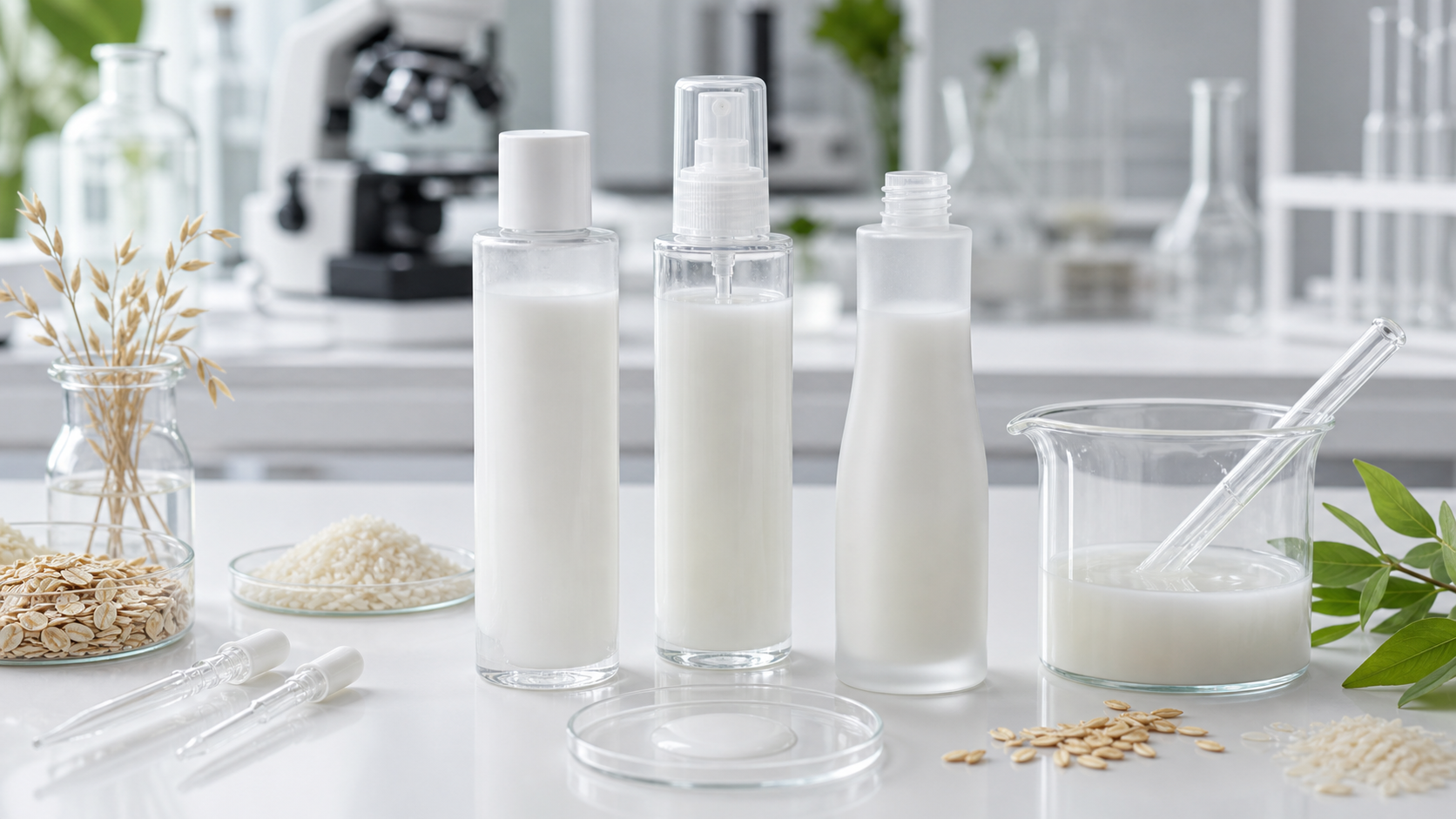
Why Milky Toner Is a Timely OEM/ODM Category
Google Trends shows continuing global interest in “milky toner.” In a worldwide comparison for the past 12 months reviewed on June 24, 2026, milky toner and rice toner each recorded an average relative interest score of 26. The result indicates a meaningful audience for hydrating, visually distinctive toner formats. Google Trends values are normalized interest scores, not absolute search volume.
Cosmetics Business reported that US Google searches for “milky toner” rose 152.9% in 2024, citing Spate, while European milky-toner launches contributed to strong growth across the lotion and toner category. A June 2026 MarkNtel Advisors report estimates the US toner market at USD 1.3 billion in 2026 and identifies hydrating toners as the leading product segment.
Trend data should guide the brief, not replace product strategy. A brand still needs a defined user, price position, skin-feel target and reason to choose the product beyond its white appearance.
Define the Milky Toner Product Architecture
1. Decide the texture position
“Milky toner” covers a wide range of viscosities. One concept may splash from an orifice reducer like a classic toner; another may dispense through a treatment pump and leave a cushiony emollient film. State the desired flow, absorption time, after-feel and layering behavior before the first sample. This prevents the laboratory from solving for appearance while missing the intended routine.
2. Choose a suitable emulsion strategy
The translucent or opaque milkiness usually comes from dispersed oil-phase materials, emulsifiers or structured delivery systems. Droplet size, oil load, electrolyte tolerance and processing conditions influence both appearance and stability. A formula that looks elegant immediately after batching may still separate, ring at the bottle wall or lose viscosity during storage if the system is not properly balanced.
3. Build a focused ingredient story
Humectants can support immediate hydration, while selected emollients and barrier-associated ingredients can improve softness and reduce a tight after-feel. Common directions may include glycerin, betaine, panthenol, squalane, ceramide systems, oat-derived materials or rice-related extracts. The final combination must fit the target pH, preservation system, texture and market claims. More actives do not automatically create a better formula.
| Design Area | Possible Direction | Buyer Approval |
|---|---|---|
| Texture | Watery milk, essence-like or light emulsion | Flow, absorption and layering |
| Benefit focus | Hydration, comfort or barrier-care positioning | Claims match formula evidence |
| Finish | Fresh, dewy, satin or low-residue | Comfort across target climates |
Preservation, pH and Formula Robustness
A milky toner contains water and may include nutrients, botanical materials or dispersed lipids, so preservation cannot be treated as an afterthought. The system should be selected for the formula’s pH, packaging, intended use and target market. Where applicable, microbiological quality and preservative-efficacy testing should be part of the validation plan.
pH affects ingredient compatibility, skin feel, color and preservative performance. Fragrance, natural extracts and high electrolyte loads can also destabilize an emulsion or change odor over time. Buyers should avoid adding late-stage actives after stability work has started; even a small change can require renewed evaluation.
Packaging Choices That Protect the Formula
Clear bottles show the milky visual clearly, while frosted or opaque packs may support a softer premium position. The practical choice depends on light sensitivity, formula interaction, decoration and dispensing. Orifice reducers suit low-viscosity products, while pumps can improve dose control for richer textures. Fine-mist pumps are only appropriate if the formula can atomize consistently without clogging.
Compatibility should be checked with the final bottle, closure, gasket and pump. Observe leakage, paneling, stress cracking, discoloration, odor transfer and dispensing consistency. If the formula needs shaking, that instruction should be supported by product behavior and communicated clearly rather than used to excuse uncontrolled separation.
Testing and Quality Control
A practical milky-toner program may include accelerated and room-temperature stability, temperature cycling, freeze-thaw exposure where relevant, centrifuge screening during development, viscosity and pH tracking, odor and color checks, package compatibility and microbiological testing. The final protocol depends on formula design and destination-market requirements.
Production control should define acceptable appearance, pH, viscosity, fill weight and microbiological limits. Scale-up also matters: mixing order, shear, temperature and cooling can change emulsion structure. A laboratory sample should therefore be followed by controlled pilot or scale-up confirmation before a large commercial batch.
From Brief to Commercial Production
| Stage | Key Work | Approval |
|---|---|---|
| 1. Brief | Market, user, texture, claims and cost | Project scope |
| 2. Sampling | Base system, ingredients and sensorial tuning | Final formula sample |
| 3. Pack matching | Bottle, closure, decoration and artwork | Pack specification |
| 4. Validation | Stability, compatibility and required testing | Release specification |
| 5. Production | Scale-up, filling, inspection and shipment | Batch QC acceptance |
MOQ depends on formula route, raw-material minimums, bottle choice, decoration and component purchasing quantities. A stock bottle and a focused ingredient brief usually create a different commercial path from a fully customized package and complex active system. Share the target quantity and launch timing at the start.
Buyer Checklist Before Requesting a Quote
- Target market, sales channel and intended user
- Desired viscosity, absorption speed and finish
- Core benefit and priority ingredients
- Ingredients, fragrance or claims to avoid
- Bottle capacity, dispensing format and decoration
- Target quantity, cost range and launch date
- Required tests, documents and labeling language
Develop a Milky Toner with Mooyam Cosmetic
Mooyam Cosmetic supports beauty brands with OEM/ODM formulation, sampling, packaging coordination, testing plans and production scale-up. Send us your target market, texture direction, ingredient priorities, quantity and packaging brief for project evaluation.
This is a factory service for brand and distribution projects. We do not sell individual retail units. Review our OEM/ODM services, see the manufacturing process, or contact Mooyam Cosmetic.
Frequently Asked Questions
Is a milky toner the same as an essence?
Not necessarily. The names can overlap in marketing, but the project should be defined by viscosity, oil phase, use level and routine position. The approved specification matters more than the front-label category name.
Can a milky toner be fragrance-free?
Yes. Fragrance-free development can be requested, but the natural odor of raw materials still needs evaluation. “Fragrance-free” labeling should follow the final ingredient composition and target-market rules.
Can rice or oat ingredients be included?
They can be considered when compatible with the formula and sourcing brief. Buyers should specify the desired ingredient type and claim, because an extract, ferment, oil and powder behave differently in formulation.
What must be approved before mass production?
Approve the final formula, appearance, odor, pH and viscosity targets, packaging components, artwork, test plan, specification, labeling and commercial terms. Do not approve production from a visual mood board alone.
Trend Reference / Sources
- Google Trends comparison, worldwide, past 12 months, reviewed June 24, 2026.
- Cosmetics Business: Milky toners, published March 11, 2025.
- MarkNtel Advisors: US Skin Toner Market 2026–2032.
- Google Search Central: Creating helpful, reliable, people-first content.