
Cushion foundation refill systems are a practical way for beauty brands to combine portable base makeup, shade flexibility, and a more considered packaging story. The opportunity is not only the compact case; it is the full system of formula, sponge, puff, refill cartridge, shade range, decoration, and quality control.
This guide explains how Mooyam Cosmetic supports cushion foundation refill OEM/ODM projects for beauty brands, importers, and distributors. Mooyam Cosmetic is a cosmetics and makeup OEM/ODM factory, and we do not accept retail orders.
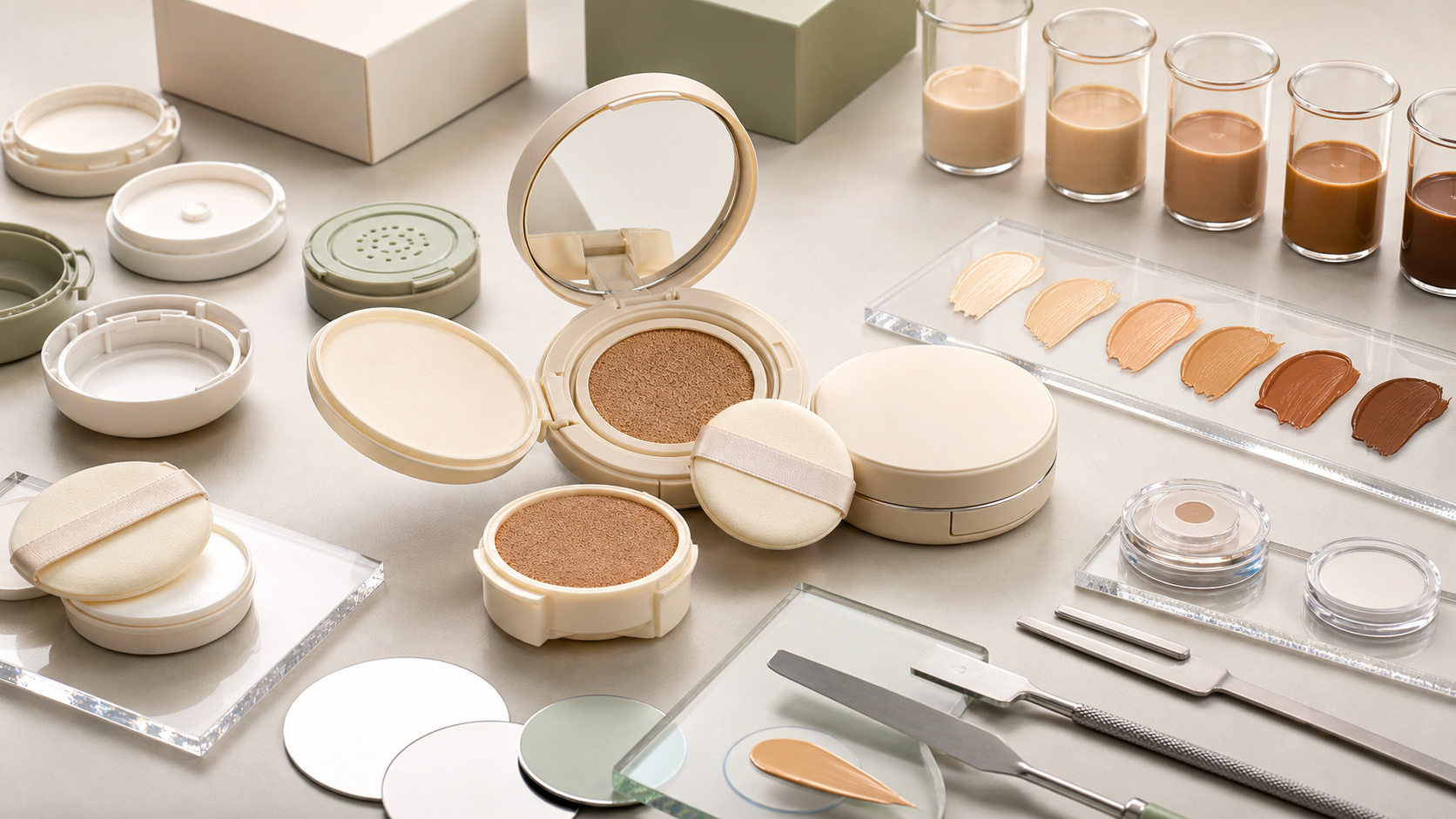
- Cushion foundation refill projects should define coverage, finish, shade range, refill format, puff feel, sponge type, and claims before sampling.
- The formula must work with the cushion sponge and cartridge, not only look good in a beaker or bottle.
- Shade planning should account for undertone, oxidation appearance, refill replacement logic, and target market skin tone range.
- Mooyam Cosmetic can help B2B buyers develop formulas, refill-compatible packaging, shade standards, stability checks, MOQ planning, and production QC.
Why Cushion Foundation Refill Systems Fit 2026 Demand
Beauty trend coverage continues to point toward skin-real complexion, portable routines, and products that feel personalized. Cushion foundation sits in that space because it offers controlled application, quick touch-up, and compact packaging. Refill systems add another buyer-friendly angle: the brand can sell the initial compact and future replacement cartridges as part of the same product family.
For OEM/ODM buyers, the refill system must be planned from the beginning. If the brand chooses a compact first and then forces the formula into it, the result can leak, dry out, separate, or deliver uneven pickup. A stronger brief defines the formula target and packaging mechanism together.
Formula Strategy: Coverage, Finish, and Sponge Pickup
Start With the Makeup Experience
A cushion foundation may be positioned as sheer skin tint, medium coverage base, natural matte foundation, dewy finish, or long-wear touch-up compact. Each route needs a different emulsion structure, pigment load, film former, humectant balance, and volatile content. The factory also needs to know whether the brand wants fragrance-free, vegan, silicone-light, alcohol-free, or SPF-related positioning. SPF claims require separate regulatory and testing planning and should not be added casually.
Mooyam Cosmetic usually recommends comparing two to three routes before final approval: a hydrating dewy cushion, a soft-matte oil-control cushion, and a medium-coverage daily cushion. This helps the buyer evaluate pickup, tap-out feel, coverage build, transfer, oxidation look, and refill compatibility.
Compatibility With Cushion Sponge
The sponge is not just a carrier. Pore size, density, compression, and wetting behavior affect how much formula releases onto the puff. A formula that feels elegant in a bottle may perform poorly inside a cushion if it dries at the surface, floods the puff, or separates inside the cartridge.
| Formula Direction | Buyer Goal | OEM/ODM Checkpoint |
|---|---|---|
| Hydrating dewy cushion | Fresh skin finish and dry-skin comfort | Sponge wetting, tackiness, transfer, preservative fit |
| Soft-matte cushion | Oil-control touch-up and blurred finish | Powder load, dry-down, sponge clogging, puff pickup |
| Medium-coverage daily cushion | Everyday complexion coverage | Pigment dispersion, shade consistency, oxidation look |
| Serum cushion | Skincare-makeup hybrid positioning | Claim boundaries, active compatibility, microbial control |
Shade Range and Refill Architecture
Refillable cushion systems make shade planning more visible. If a brand sells replacement cartridges, the shade code, undertone, batch standard, and carton identification must be clear. A refill that looks almost correct in the compact can still disappoint buyers if the undertone changes between production runs.
A practical launch can start with a focused shade range, but it should still consider undertone and depth. Porcelain, light neutral, light warm, medium neutral, tan, caramel, and deep options may be more useful than a narrow three-shade launch if the brand sells online or exports across regions. Mooyam Cosmetic can help create shade drawdowns and production standards so bulk batches stay closer to the approved master.
Packaging: Compact, Refill Cup, Puff, and Carton
Reusable compacts and replacement cups need precise fit. The refill should snap securely, release cleanly, and protect formula from drying. The puff should sit neatly above the inner lid without absorbing too much product. Mirror quality, hinge strength, magnet or clasp durability, and decoration wear should all be checked before mass production.
For first orders, stock compact systems are often more reliable than custom tooling. Buyers can customize shell color, top plate, carton, label, or sleeve while keeping the mechanical fit proven. Custom molds can be considered after the brand confirms refill sales and repeat demand.
OEM/ODM Development Flow
| Stage | Buyer Provides | Factory Output |
|---|---|---|
| 1. Product brief | Finish, coverage, shade map, target market, compact preference | Formula route, component options, MOQ and timeline estimate |
| 2. Lab sampling | Feedback on coverage, finish, pickup, shade and wear | Adjusted formula, sponge trial, shade drawdowns |
| 3. Packaging compatibility | Selected compact, refill cup, puff and carton direction | Leakage, drying, drop, hinge, refill fit and puff pickup checks |
| 4. Bulk production | Artwork, shade standard, inspection plan, order quantity | Pilot batch, final sample, filling records, QC and packing support |
Buyer Checklist Before Sampling
- Define finish, coverage, target customer, claims, and whether the compact must include a refill cartridge.
- Decide whether the first launch needs stock packaging, semi-custom decoration, or a custom compact system.
- Provide target shade depth and undertone expectations, not only a benchmark product photo.
- Test formula pickup with the exact sponge, puff, inner lid, and refill cup planned for production.
- Confirm carton and refill labeling rules so customers can identify the correct replacement shade.
- Ask for stability, leakage, drying, drop, microbial, color, odor, viscosity, and packaging function checks.
Claims, MOQ, and Quality Control
Cushion foundation can easily become overclaimed. Words such as waterproof, 24-hour wear, SPF, non-comedogenic, or skincare treatment need appropriate support in the target market. Cosmetic appearance claims such as fresh finish, buildable coverage, soft-focus look, or comfortable wear are easier to manage when the formula and testing match the claim.
MOQ planning should separate formula batch, compact shell, refill cup, puff, mirror, carton, and decoration. Mooyam Cosmetic can help B2B buyers build a practical first order by choosing a proven component system, defining shade priorities, and setting inspection standards that protect repeat orders.
If your brand is planning a cushion foundation refill range, send Mooyam Cosmetic your target finish, coverage, shade map, compact style, refill requirement, claim direction, expected MOQ, and launch market. We can review formula feasibility, packaging compatibility, shade development, sampling timeline, and QC planning for private label, OEM, or ODM production. Mooyam Cosmetic works with B2B buyers only and does not accept retail orders.
FAQ
Can Mooyam Cosmetic develop both the compact and refill cartridge?
Yes. Mooyam Cosmetic can help B2B buyers match cushion foundation formula, sponge, refill cartridge, compact shell, puff, carton, and production QC requirements.
How many shades should a cushion foundation launch include?
It depends on the target market and budget. A practical range should consider both depth and undertone, especially if the brand sells online or exports across regions.
Can a cushion foundation include SPF claims?
SPF claims require market-specific testing and regulatory planning. Buyers should not add SPF language unless the formula, testing, and registration path support it.
What are the key tests before bulk production?
Check formula stability, shade consistency, sponge pickup, leakage, drying, drop resistance, puff quality, mirror and hinge function, refill fit, microbial quality, and packaging abrasion.
The links below are used only for beauty trend, technology, SEO direction, labeling, and color compliance background. This article is original B2B OEM/ODM procurement guidance and is not copied, translated, or structured from the source pages.