A custom serum can help a beauty brand stand out, but it is also one of the product types where unclear briefs, unstable textures, packaging mismatch, and exaggerated claims can create delays. This anonymous case-style guide explains how Mooyam Cosmetic would support a beauty brand from early concept to approved sample and production planning without disclosing any client information.
The article is written for overseas skincare startups, Amazon sellers, DTC brands, distributors, and sourcing managers who are evaluating a custom serum case study before contacting a cosmetic OEM manufacturer or cosmetic ODM manufacturer. Mooyam Cosmetic supports brand and wholesale OEM/ODM projects only; we do not accept retail orders.
Quick Summary
- A successful custom serum project starts with a clear product brief, target market, texture benchmark, packaging plan, MOQ expectation, and claim boundary.
- The factory’s role is to translate brand direction into sample development, formula adjustment, packaging sourcing, quality control, and bulk production planning.
- Custom formulation usually needs more structured feedback than private label skincare, but it can support stronger differentiation.
- Requirements vary by destination market, so cosmetic claims and product information should be reviewed before artwork and production.
Project Background: A Brand Wanted a Differentiated Serum
In this anonymous example, the buyer wanted a lightweight serum for an international skincare line. The brand needed a product that could work as a hero item, fit a premium routine, and still remain practical for MOQ, packaging, and export planning. The buyer had a target customer and several benchmark textures, but the formula route, claims language, bottle style, and launch cost were not fully defined.
This is a common starting point. Many brands know they want a serum, but they need help turning the idea into a manufacturable product. Mooyam first clarifies whether the project should use private label skincare, ODM adjustment, OEM production, or custom formulation. In this case, custom formulation made sense because the buyer wanted a specific skin feel and a more original product story.
Step 1: Turning the Brief into a Formula Direction
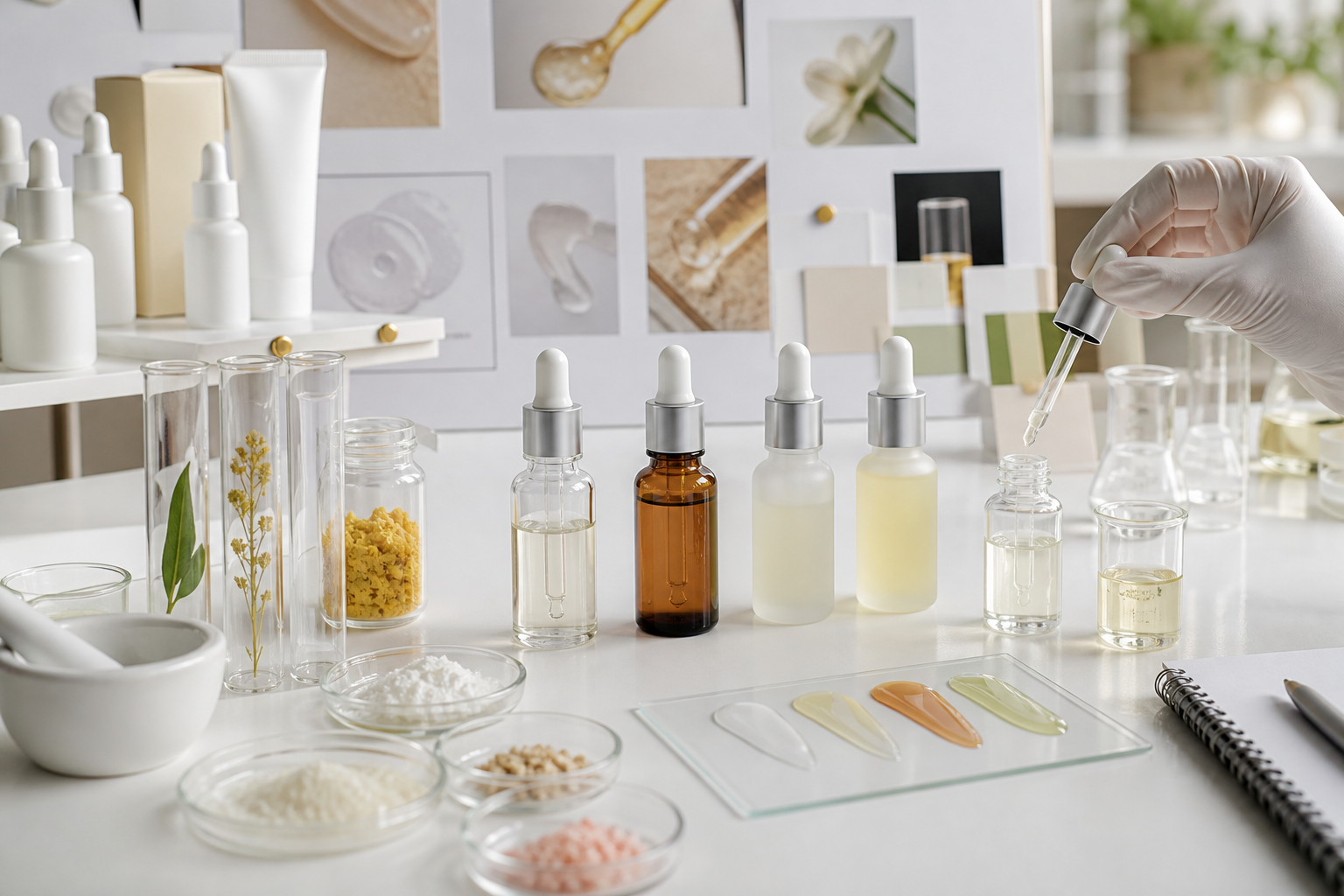
The first task was to make the brief specific enough for lab work. The buyer provided target market, sales channel, benchmark serum texture, desired skin feel, preferred ingredients, ingredients to avoid, fragrance direction, cost range, packaging ideas, and estimated first order quantity. Mooyam reviewed which points were flexible and which were essential.
A strong brief prevents the lab from guessing. For example, “lightweight hydrating serum for humid climates with fast absorption and low tack” is much clearer than “premium serum.” It tells the cosmetic ODM manufacturer how to balance viscosity, humectants, sensory modifiers, fragrance, packaging, and sample review.
| Project Stage | Buyer Input | Factory Output |
|---|---|---|
| Concept review | Target user, channel, benchmark, hero product role, price tier. | Feasibility comments and recommended manufacturing route. |
| Formula direction | Texture, skin feel, ingredient preferences, restrictions, fragrance. | Custom formulation plan and first sample direction. |
| Packaging review | Dropper, airless pump, bottle color, carton, decoration, MOQ. | Packaging sourcing options and compatibility notes. |
| Sample feedback | Absorption, tack, viscosity, scent, color, routine fit. | Revised sample and documented change logic. |
| Production planning | Approved sample, artwork, order quantity, target shipment time. | Bulk production schedule, QC plan, and export coordination. |
Step 2: Sample Development and Feedback
After the formula direction was confirmed, the lab prepared first-round samples. The buyer reviewed appearance, color, odor, viscosity, spread, absorption, tack, after-feel, and how the serum layered with moisturizer or sunscreen. The most useful feedback was specific: reduce tack, keep the lightweight finish, soften fragrance, and improve the premium feel without making the serum heavy.
Custom formulation is an iterative process. A responsible manufacturer should explain what changed between samples and why. If the buyer asks for more viscosity, faster absorption, lower cost, stronger ingredient story, and different packaging at the same time, the factory should help prioritize decisions rather than making random changes.
Step 3: Matching Formula with Packaging
The buyer initially preferred a dropper bottle, but the final choice needed to fit viscosity, dosing, appearance, leakage risk, label area, decoration, carton structure, and MOQ. Mooyam’s packaging sourcing support helped compare dropper bottles, airless pumps, stock components, decoration routes, and carton options. The decision was made before final stability direction because packaging can affect formula compatibility and user experience.
Packaging is not just a design decision. It affects filling speed, component lead time, cost, shipping weight, breakage risk, label adhesion, and reorder planning. For low MOQ launches, standard components often help reduce cash pressure and shorten the first production cycle.
Step 4: Claims, Market Requirements, and Artwork
The brand wanted strong consumer-facing language, but serum claims must stay within cosmetic boundaries. Mooyam helped review practical wording and reminded the buyer that requirements vary by destination market, product type, importer responsibility, and sales channel. No factory should promise universal regulatory approval for every market.
Before printing, the buyer needed to align product name, ingredient list, directions, warnings where needed, volume, batch coding area, carton text, barcode, and claim direction. Mooyam’s quality control and compliance information supports this discussion, while the buyer remains responsible for confirming final target-market requirements with the appropriate party.
Step 5: Moving from Approved Sample to Bulk Production
Once the final sample was approved, the project moved into quotation confirmation, packaging purchase, artwork proof, material preparation, production scheduling, filling, inspection, packing, and export support. The approved sample became the sensory and appearance reference for bulk production. Production records and retained samples helped keep the project traceable.
Through Mooyam’s OEM/ODM cosmetic manufacturing service, the buyer had one coordinated process for formula, packaging, sample development, low MOQ planning, bulk production, quality control, and export communication. That coordination reduced the risk of approving a formula that could not be filled or packaged efficiently.
Buyer Checklist for a Custom Serum Project
- Define target market, channel, product role, price tier, and launch timing before asking for samples.
- Share benchmark products for texture direction, but do not ask the factory to copy another brand.
- Decide whether the project needs private label, ODM adjustment, OEM production, or full custom formulation.
- Confirm texture, fragrance, ingredient preferences, ingredients to avoid, and claim boundaries.
- Discuss packaging early, including dropper, pump, bottle, label, carton, decoration, MOQ, and compatibility.
- Give specific sample feedback on absorption, tack, viscosity, scent, color, and routine fit.
- Review quality control checks, artwork, export support, and production timeline before placing the bulk order.
Lessons from the Case
The main lesson is that custom serum development is a decision process. The project moved smoothly because the buyer clarified priorities, reviewed samples carefully, and confirmed packaging before bulk production. The factory also explained tradeoffs instead of treating every request as a simple change.
For B2B buyers, the best result is not only an attractive lab sample. The real goal is a formula and packaging combination that can be repeated in production, inspected against clear standards, shipped efficiently, and reordered when the product begins selling.
Develop a Custom Serum with Mooyam Cosmetic
Looking for a reliable cosmetic OEM/ODM manufacturer for a custom serum or private label skincare line? Contact Mooyam Cosmetic to discuss your formula requirements, packaging options, MOQ, sample development, production solution, quality control, and export support. We serve brand and wholesale projects, not retail orders.
FAQ
How long does a custom serum project usually take?
Timing depends on formula complexity, packaging decisions, sample feedback speed, testing needs, and target market requirements. Custom formulation usually takes longer than stock private label skincare.
Can Mooyam Cosmetic develop a serum from only a product idea?
Yes, a product idea can be developed into a clearer brief, but the buyer should provide target market, texture expectations, packaging direction, MOQ, and claim preferences before sampling.
Is a dropper bottle always best for serum?
No. Droppers, airless pumps, tubes, and bottles can all work depending on formula viscosity, oxidation sensitivity, dose control, cost, and brand positioning.
Can I use my own formula for a serum?
Yes, OEM production may be possible if the buyer provides a formula, specification, or sample for feasibility review. The factory still needs to check raw materials, processing, packaging fit, and quality control expectations.
How many sample revisions are normal?
Many projects need one to three revision rounds, but this varies by texture difficulty, ingredient direction, packaging compatibility, and how specific the buyer’s feedback is.
Can Mooyam Cosmetic guarantee cosmetic compliance in every country?
No responsible manufacturer should guarantee universal approval. Requirements vary by destination market, product type, claims, importer role, and sales channel.
Does Mooyam Cosmetic accept retail serum orders?
No. Mooyam Cosmetic works with B2B beauty brands, private label buyers, distributors, and wholesale OEM/ODM projects only.
Related manufacturing guides: A custom serum project benefits from a supplier’s international brand manufacturing experience and cosmetic R&D capability.