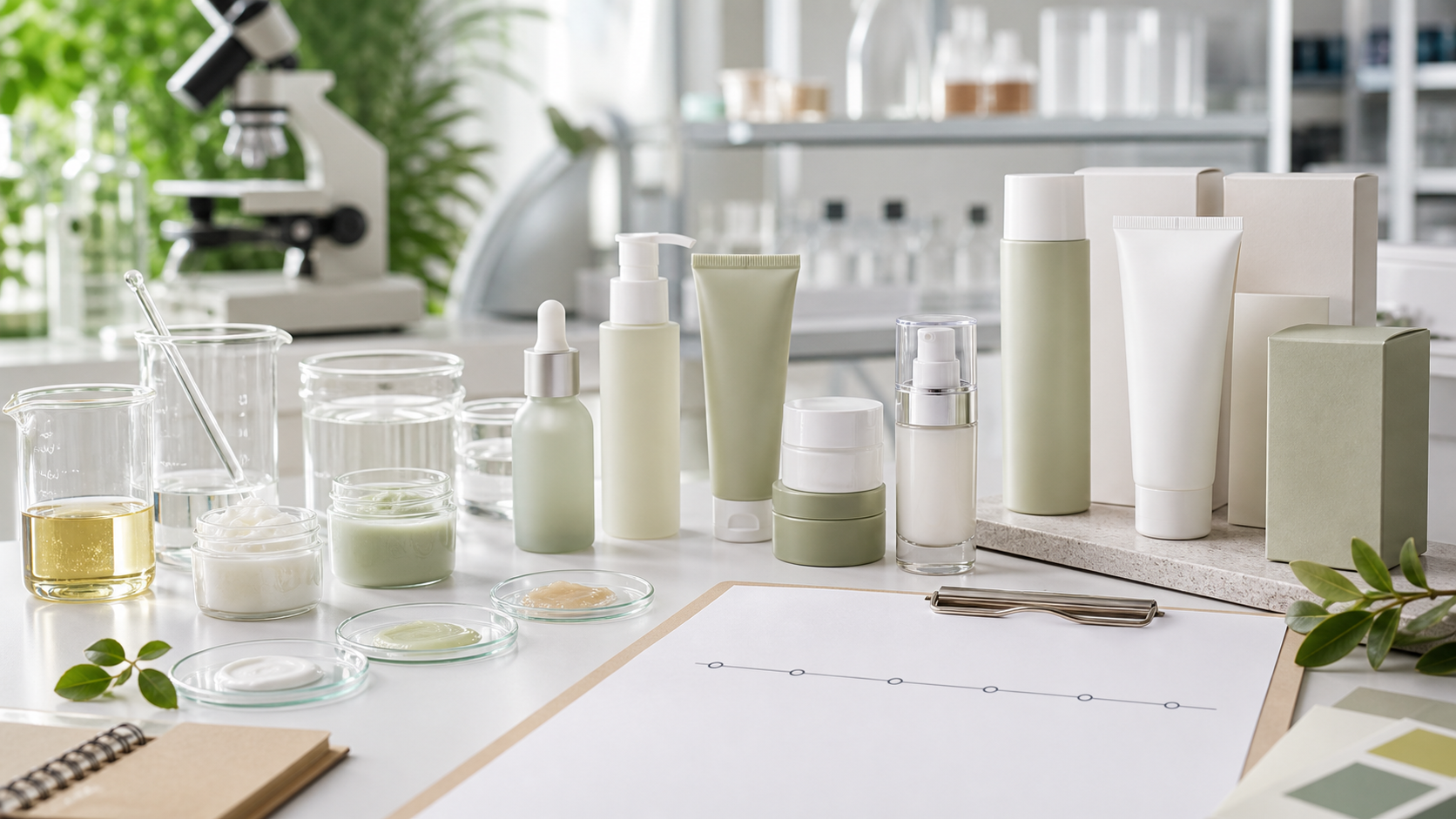
A skincare product usually begins as a simple idea: a texture, ingredient direction, market gap, or customer request. Turning that idea into a finished private label or custom product requires more than a formula sample. The brand must align product positioning, manufacturing route, packaging, MOQ, quality control, and export preparation before launch.
This anonymous case study shows how a beauty brand can move from formula idea to finished skincare product with a cosmetic OEM manufacturer and cosmetic ODM manufacturer. It is written for overseas founders, Amazon sellers, DTC brands, distributors, and sourcing managers. Mooyam Cosmetic serves B2B brand and wholesale OEM/ODM projects only; we do not accept retail orders.
Quick Summary
- The strongest product ideas become launchable only when the formula, packaging, MOQ, claims, and quality plan are connected.
- A mixed route can work well: private label skincare for speed, custom formulation for hero-product differentiation.
- Packaging sourcing should start early because component MOQ and compatibility can change the whole project plan.
- Quality control and market responsibility should be discussed before artwork printing and bulk production.
Project Background: A Brand Had a Formula Idea, Not a Production Plan
The buyer in this example was preparing a small skincare line for online sales and distributor conversations. The initial idea was a hydrating serum with a lightweight texture, a moisturizer that felt comfortable under makeup, and simple packaging that looked professional without expensive custom molds. The brand had benchmark products and mood boards, but did not yet have a factory-ready brief.
Mooyam Cosmetic first helped the buyer separate creative preferences from production decisions. A product idea can be emotional and flexible. A production plan must be specific: target markets, product format, texture, fragrance, hero ingredient direction, claims, packaging style, order quantity, budget range, and launch timing.
Step 1: Choosing the Right Manufacturing Route
The buyer wanted uniqueness but also needed a realistic launch schedule. Full custom development for every SKU would have increased sample rounds, cost, and timeline. A better route was to use private label skincare for the moisturizer and a more customized route for the serum. This balanced speed with differentiation.
Mooyam Cosmetic reviewed the brand’s target customer, sales channel, and cost expectations, then explained how cosmetic OEM/ODM service could support both routes. OEM can work when the buyer has a clear formula or specification. ODM support is useful when the buyer needs factory guidance on product direction, formula route, and packaging choices.
| Decision | Chosen Route | Reason |
|---|---|---|
| Hero serum | Custom formulation | The brand needed a specific texture, ingredient story, and sensory profile. |
| Daily moisturizer | Private label base with selected adjustments | The product needed speed, lower development risk, and manageable MOQ. |
| Packaging | Standard components with coordinated decoration | This avoided custom mold cost while keeping a coherent brand look. |
| Launch scope | Focused first line | A smaller range reduced inventory pressure and simplified approvals. |
Step 2: Translating the Idea into a Product Brief
The first practical milestone was a clear product brief. The buyer provided benchmark products, preferred textures, ingredient directions, forbidden ingredients, fragrance preference, target price, destination markets, and packaging references. This allowed the factory to judge feasibility instead of guessing.
For the serum, custom formulation development focused on texture, absorption, viscosity, packaging compatibility, and realistic cosmetic claims. For the moisturizer, the team compared existing formula bases and selected the one closest to the buyer’s desired finish. The brand avoided medical or guaranteed claims and kept market-specific language for later review.
Step 3: Sample Development and Feedback
Sample development moved through several rounds. The first serum sample had the right ingredient direction but felt too sticky. The second improved absorption but needed better viscosity for the selected pump. The moisturizer sample was closer from the start, but the buyer requested a softer fragrance level and a slightly lighter after-feel.
Specific feedback made revisions efficient. Instead of saying a sample should feel more premium, the buyer described what needed to change: less tackiness, faster absorption, softer fragrance, smoother pump output, and a cleaner finish under makeup. That kind of feedback helps the lab respond with practical adjustments.
Step 4: Packaging Sourcing and Compatibility
Packaging became a key cost and timeline decision. The buyer originally wanted a custom colored airless bottle for both products. After reviewing MOQ and lead time, the team selected standard airless and tube options with coordinated label and carton design. This made the line look consistent while keeping launch risk controlled.
Mooyam Cosmetic supported packaging sourcing by comparing pump output, bottle size, tube material, carton area, decoration method, and component availability. Compatibility mattered because serum viscosity and pump performance had to work together. Packaging was treated as part of product development, not just a design decision.
Step 5: Preparing for Bulk Production
Before bulk production, the buyer approved the final formula samples, packaging components, artwork, order quantity, and target schedule. The factory confirmed raw material availability, packaging lead time, filling approach, retained sample plan, and inspection points. This stage prevented late changes after materials were already purchased.
Quality control included appearance, odor, color, viscosity, pH where relevant, fill weight, packaging function, label placement, carton packing, and retained samples. Mooyam Cosmetic also reviewed quality control and compliance considerations with the buyer. Requirements can vary by destination market, claim language, product type, importer responsibility, and sales channel, so final market review remained important.
Results: What Made the Project Work
The project succeeded because the brand did not try to customize everything at once. It focused custom work where differentiation mattered most and used a practical private label route where speed and MOQ mattered more. The packaging direction stayed professional without forcing unnecessary custom molds. The sample feedback was specific, and approvals were documented before bulk production.
The outcome was not only finished skincare products. The buyer gained a repeatable development process: brief, route selection, samples, packaging, quality checks, production, and export support. That process is what helps new brands launch more smoothly and plan future reorders with fewer surprises.
Buyer Checklist from This Case Study
- Write a product brief before asking for a quotation.
- Decide which SKUs need custom formulation and which can use private label bases.
- Share benchmark products with clear likes and dislikes.
- Choose packaging early and check MOQ, lead time, filling, and compatibility.
- Give sample feedback in practical terms: texture, scent, viscosity, pump output, and after-feel.
- Approve artwork only after ingredient, claim, and destination-market review.
- Confirm quality control points and retained samples before mass production.
FAQ
Is custom formulation always better than private label skincare?
No. Custom formulation offers more differentiation, but private label skincare can be faster and more cost efficient. Many brands use both routes in one launch.
How many sample rounds are normal?
It depends on formula complexity and feedback clarity. A clear brief and specific comments usually reduce unnecessary revisions.
Can packaging change after formula approval?
It can, but changing packaging late may require compatibility review, new artwork, different MOQ, and schedule changes.
What should a brand prepare before contacting a factory?
Prepare target market, product type, benchmark samples, texture goals, packaging ideas, MOQ range, budget level, and launch timeline.
Can Mooyam support low MOQ startup projects?
Low MOQ may be possible depending on formula type, packaging choice, decoration method, and product scope. Standard packaging usually helps.
Who is responsible for market compliance?
The brand or importer should confirm local requirements. The factory can support available product information and production documents, but requirements vary by destination.
Does Mooyam accept retail orders?
No. Mooyam Cosmetic focuses on B2B cosmetic OEM/ODM, private label, and wholesale manufacturing projects.
Turn Your Formula Idea into a Finished Product
Looking for a reliable cosmetic OEM/ODM manufacturer for your next skincare launch? Mooyam Cosmetic can help with private label skincare, custom formulation, packaging sourcing, sample development, low MOQ planning, bulk production, quality control, and export support. Contact us to discuss your product idea, formula requirements, packaging options, MOQ, and production solution.