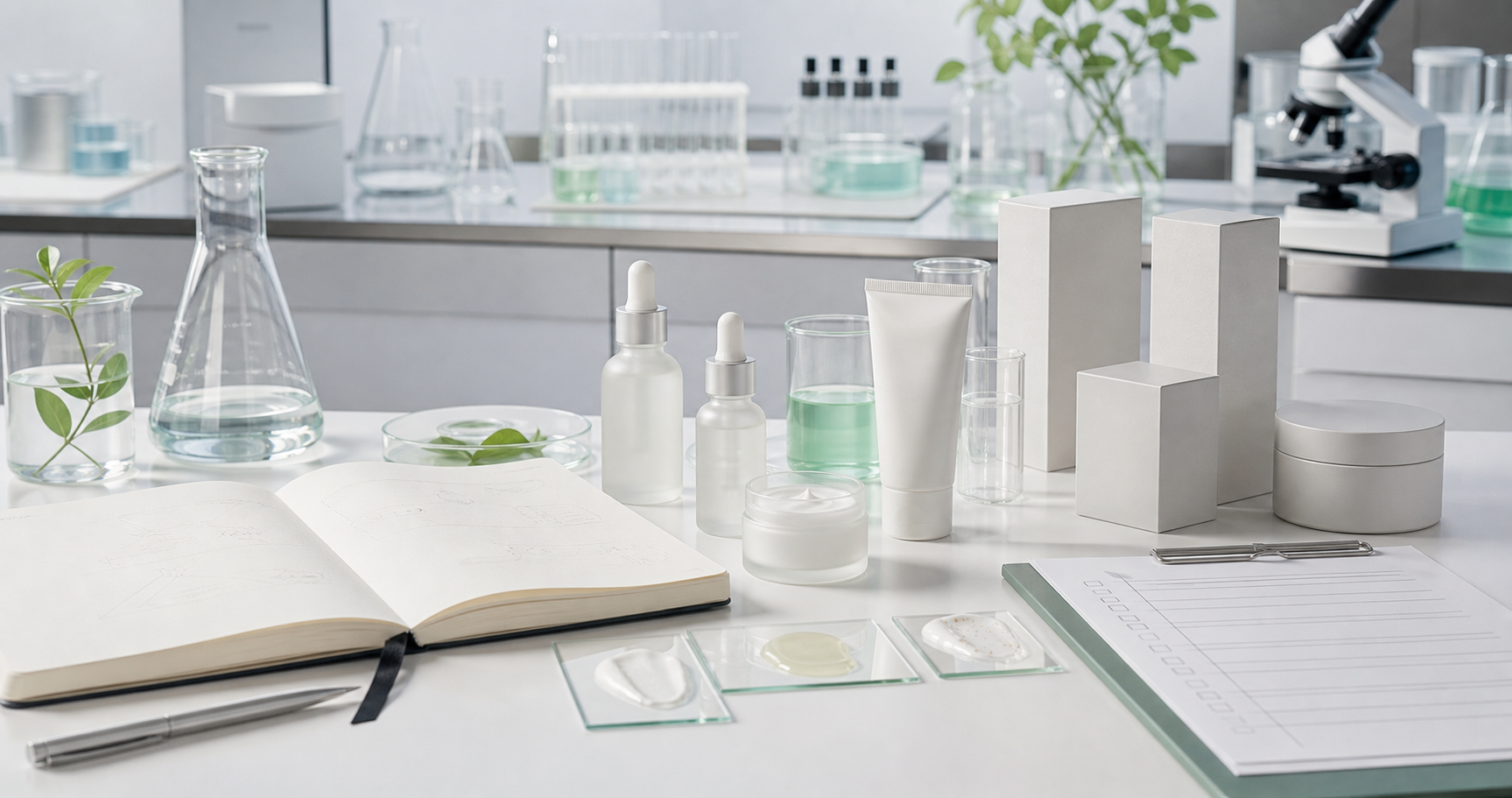
A skincare product often starts as a simple commercial idea: a texture, a hero ingredient, a target customer, or a gap in a brand’s current line. Turning that idea into a finished product requires more than a sample that feels good on the hand. Overseas buyers need a manufacturable formula, compatible packaging, clear cost assumptions, realistic MOQ planning, quality control steps, and export support before bulk production begins.
This anonymous case study shows how a beauty startup can move from a formula concept to a finished private label skincare product with an experienced cosmetic OEM manufacturer. The details are simplified to protect client information, but the workflow reflects common decisions Mooyam Cosmetic handles for brand owners, Amazon sellers, DTC teams, distributors, and procurement managers.
- A formula idea becomes commercially useful only when it is matched with positioning, packaging, MOQ, testing, and production controls.
- Early decisions about benchmark texture, target market, claims, fragrance, and cost range help the factory avoid slow sample revisions.
- Packaging sourcing should run alongside formula work because bottles, pumps, tubes, labels, and cartons affect stability, filling, MOQ, and launch timing.
- Mooyam Cosmetic supports B2B clients through cosmetic OEM and ODM manufacturing projects, from product brief to bulk production.
Project Background: A Startup With a Clear Product Direction
The buyer in this example was preparing a small but focused skincare launch for an overseas market. The brand wanted a daily-use moisturizer-serum hybrid positioned around hydration, lightweight comfort, and a clean modern routine. They had a few benchmark products, a preferred texture direction, and a target retail price, but no finalized formula, packaging, or production plan.
This is a common starting point for private label skincare buyers. The brand understands its audience, but it needs a cosmetic ODM manufacturer to translate the idea into a formula and manufacturing route. At the first discussion, Mooyam Cosmetic asked for the target market, sales channel, ingredient preferences, prohibited ingredients, packaging inspiration, estimated order quantity, and launch schedule. These details allowed our team to recommend a practical development path instead of creating samples in isolation.
Step 1: Turning the Idea Into a Factory Brief
A good factory brief does not need to be overly technical, but it should be specific enough for sample development. For this project, the buyer confirmed a lightweight emulsion texture, a non-sticky finish, minimal fragrance, and packaging suitable for both DTC shipping and distributor presentation. The target was a premium but accessible product, so every choice had to balance sensory quality with cost control.
Mooyam Cosmetic helped the buyer separate must-have requirements from flexible preferences. Hydration story, smooth texture, and stable pump packaging were important. Exact botanical extracts and carton finish were flexible at the first stage. This distinction matters because too many fixed requirements can slow custom formulation and increase cost before the brand has validated product-market fit.
Step 2: Formula Route and Sample Development
The R&D team created an initial formula route based on hydration support, skin-feel modifiers, emulsion stability, preservative system, and compatibility with pump packaging. The goal was not to promise medical effects or make treatment claims. It was to create a cosmetic product with a pleasant user experience and claims that could be reviewed for the target market.
During sampling, the buyer received several versions with different viscosity, absorption speed, and after-feel. Feedback was collected in practical terms: less tack, faster spread, softer finish, lower scent, and better cushion. This type of feedback is more useful than general comments such as “make it better.” A cosmetic OEM manufacturer can revise efficiently when the buyer describes texture, appearance, fragrance, and packaging behavior clearly.
| Development Stage | Buyer Input | Factory Output | Decision Point |
|---|---|---|---|
| Concept brief | Target customer, product role, price range, benchmark texture, claims direction. | Feasibility review and recommended formulation route. | Confirm whether the concept fits OEM, ODM, or deeper custom formulation. |
| Lab samples | Texture feedback, fragrance tolerance, ingredient preferences, usage routine. | Sample versions with adjusted feel, viscosity, and stability direction. | Choose the most commercial sample before packaging lock. |
| Packaging match | Bottle type, pump preference, label area, carton style, shipment channel. | Packaging sourcing options and compatibility checks. | Confirm pack before final stability and artwork preparation. |
| Pre-production | Approved sample, artwork files, order quantity, shipping plan. | Bulk production plan, QC checklist, filling and packing standards. | Approve production sample and final documents. |
Step 3: Packaging Sourcing and Cost Alignment
Packaging can change a project’s cost, lead time, and quality risk as much as the formula. In this case, the buyer initially wanted a premium airless bottle with a decorated carton. After reviewing MOQ, pump compatibility, label area, and shipping needs, the team chose a practical pump bottle with a clean carton structure. The result still supported brand positioning but reduced unnecessary startup pressure.
For brands that need customized cosmetic packaging support, early coordination is important. Bottle availability, decoration MOQ, carton lead time, label material, pump output, leakage testing, and export packing all influence launch timing. Packaging should not be treated as a final decoration step after the formula is already locked.
Step 4: Quality Control Before Bulk Production
Once the buyer approved the final sample, Mooyam Cosmetic moved the project into pre-production control. The team checked raw material standards, formula batch records, packaging samples, filling weight targets, appearance standards, and retained sample requirements. Stability and compatibility checks were aligned with the formula type, packaging, and market expectations.
Quality control does not mean a factory can guarantee approval in every country. Requirements vary by target market, sales channel, and product claim. A responsible factory helps buyers understand the documents and checks that may be needed, while the brand remains responsible for confirming local compliance before sale. Buyers can review Mooyam’s quality control and compliance support before placing an order.
What the Buyer Learned
The most important lesson was that product development is a chain of connected decisions. A richer formula may require different packaging. A decorative bottle may raise MOQ. A late artwork change may delay production. A claim that sounds attractive may need revision for the target market. When these issues are discussed early, the buyer can launch more smoothly.
The project also showed why startups should share commercial constraints. A factory cannot recommend the right solution if the brand hides its target cost, order quantity, or channel plan. Clear constraints help the cosmetic OEM manufacturer propose realistic options for sample development, packaging sourcing, low MOQ production, bulk production, and export support.
Buyer Checklist Before Starting a Similar Project
- Define the product role in your line: hero product, entry product, bundle item, refill, or distributor SKU.
- Prepare benchmark textures, but do not ask the factory to copy another brand’s formula or packaging.
- Confirm your target market, sales channel, preferred claim style, ingredient restrictions, and fragrance direction.
- Set a realistic cost range, MOQ expectation, packaging style, and launch timeline before sampling.
- Ask how custom formulation will affect testing, sample revisions, and production preparation.
- Review artwork, label language, packaging compatibility, and QC standards before approving bulk production.
How Mooyam Cosmetic Supports Similar Projects
Mooyam Cosmetic works with business clients that need private label skincare manufacturing, OEM production, ODM product development, packaging sourcing, sample adjustment, quality control, and export-ready project coordination. We help brands move from a product idea to a finished cosmetic item through a practical process built around commercial decisions, not retail promises.
We do not accept retail orders. Our service is designed for overseas beauty brands, startup founders, Amazon and DTC sellers, distributors, spas, salons, and sourcing managers planning wholesale OEM/ODM projects.
Start Your Product Development Brief
Looking for a reliable cosmetic OEM/ODM manufacturer for your next skincare product? Contact Mooyam Cosmetic to discuss your formula idea, target market, packaging options, MOQ, sample development needs, bulk production plan, and quality control requirements.
FAQ
Can a brand start with only a formula idea?
Yes. A clear formula idea can be enough for the first discussion if the buyer can also explain target market, texture, packaging direction, MOQ expectation, and launch channel.
Is ODM faster than full custom formulation?
Often, yes. ODM can start from an existing formula base and adjust texture, fragrance, actives, and packaging. Full custom formulation may take longer because more technical validation is needed.
How many sample rounds are normal?
Many projects need two or three rounds, but this depends on formula complexity, buyer feedback quality, packaging decisions, and testing requirements.
When should packaging be selected?
Packaging should be discussed early and confirmed before final stability and compatibility checks. Bottle, pump, tube, jar, label, and carton choices can affect formula behavior and production timing.
Can Mooyam Cosmetic help with low MOQ startup projects?
Mooyam Cosmetic can discuss low MOQ options when the formula, packaging, and production route allow it. MOQ depends on formula type, packaging availability, decoration method, and raw material requirements.
Does the factory guarantee regulatory approval?
No. Cosmetic requirements vary by target market. The factory can support documentation and general compliance checks, but the buyer should confirm local rules before selling.
Does Mooyam sell finished products to consumers?
No. Mooyam Cosmetic supports wholesale OEM/ODM projects for business clients and does not accept retail orders.