A good cosmetic OEM/ODM factory does more than quote a low unit price. For overseas beauty brands, the right factory should understand product development, private label skincare, custom formulation, packaging sourcing, low MOQ planning, bulk production, quality control, and export communication. It should help the buyer turn an idea into a manufacturable product without hiding risk.
This guide explains what makes a good cosmetic OEM/ODM factory from a practical B2B sourcing perspective. It is written for beauty startups, Amazon sellers, DTC brands, distributors, salon brands, and procurement managers comparing manufacturers in China or other sourcing markets. Mooyam Cosmetic works with brand and wholesale OEM/ODM projects; we do not accept retail orders.
Quick Summary
- A good cosmetic OEM/ODM factory has clear development capability, realistic MOQ advice, stable packaging sourcing, transparent quotation, and documented quality control.
- Buyers should evaluate communication quality, sample process, formula options, packaging compatibility, production planning, and export support before paying a deposit.
- The best factory for a startup may not be the same as the best factory for a large retail launch; fit matters.
- Mooyam Cosmetic supports OEM/ODM manufacturing, private label skincare, custom formulation, packaging, QC, and B2B project communication.
Start With Factory Fit, Not Only Factory Size
Many buyers begin by asking whether a factory is big. Size can matter, but fit matters more. A very large factory may be strong for high-volume repeat orders but slow for a startup that needs guidance. A smaller factory may communicate well but lack the R&D or packaging coordination needed for a complex project. The right choice depends on product category, MOQ, formula route, packaging needs, target market, and launch timeline.
A good cosmetic OEM/ODM factory should explain what it can manufacture, what it cannot support, and which route is most practical for your brand. If a supplier says yes to every request without asking about formula, packaging, MOQ, claims, or target market, the buyer should slow down and ask for more detail.
Clear Product Development Capability
OEM and ODM buyers need different types of support. OEM projects may start from the buyer’s formula, benchmark, or technical brief. ODM projects may rely more on factory formula options, product concepts, and existing development experience. Private label projects may focus on faster launch, available formulas, and standard packaging. A good factory can explain these routes clearly.
For private label skincare, buyers should ask what product types are available, how samples are selected, what can be adjusted, and what MOQ applies. For custom formulation, buyers should ask about sample rounds, feasibility review, ingredient direction, fragrance, texture, stability review, and how final approval is recorded.
The factory does not need to reveal confidential formulas to prove capability. It should be able to discuss development process, sample logic, technical limits, expected timeline, and buyer responsibilities in a professional way.
Practical MOQ and Cost Guidance
A good factory does not use MOQ as a vague sales answer. It explains why MOQ exists. MOQ may come from formula batch size, packaging component minimums, decoration method, carton order quantity, filling efficiency, or raw material purchase requirements. A low MOQ may be possible with an existing formula and standard packaging, while custom packaging or special ingredients may increase minimums.
Buyers should compare quotations on the same basis. One quote may include packaging decoration, carton, filling, testing, and export packing, while another may only include bulk formula and basic filling. The cheapest option can become more expensive if it excludes packaging sourcing, sample development, quality control, or rework risk.
| Evaluation Area | Good Factory Signal | Buyer Risk if Missing |
|---|---|---|
| Formula route | Explains private label, OEM, ODM, and custom options clearly | Wrong development path, wasted samples, unclear ownership |
| MOQ and cost | Breaks down formula, packaging, decoration, carton, and testing drivers | Unexpected cost, excess inventory, launch delay |
| Packaging | Reviews compatibility, lead time, decoration, leakage, and export packing | Component failure, poor appearance, higher defect rate |
| Quality control | Uses approved samples, specifications, batch records, inspection, retained samples | Inconsistent batches and weak problem resolution |
| Communication | Documents decisions, identifies risks, and gives realistic timelines | Misunderstanding, late changes, unclear responsibility |
Packaging Sourcing and Compatibility Support
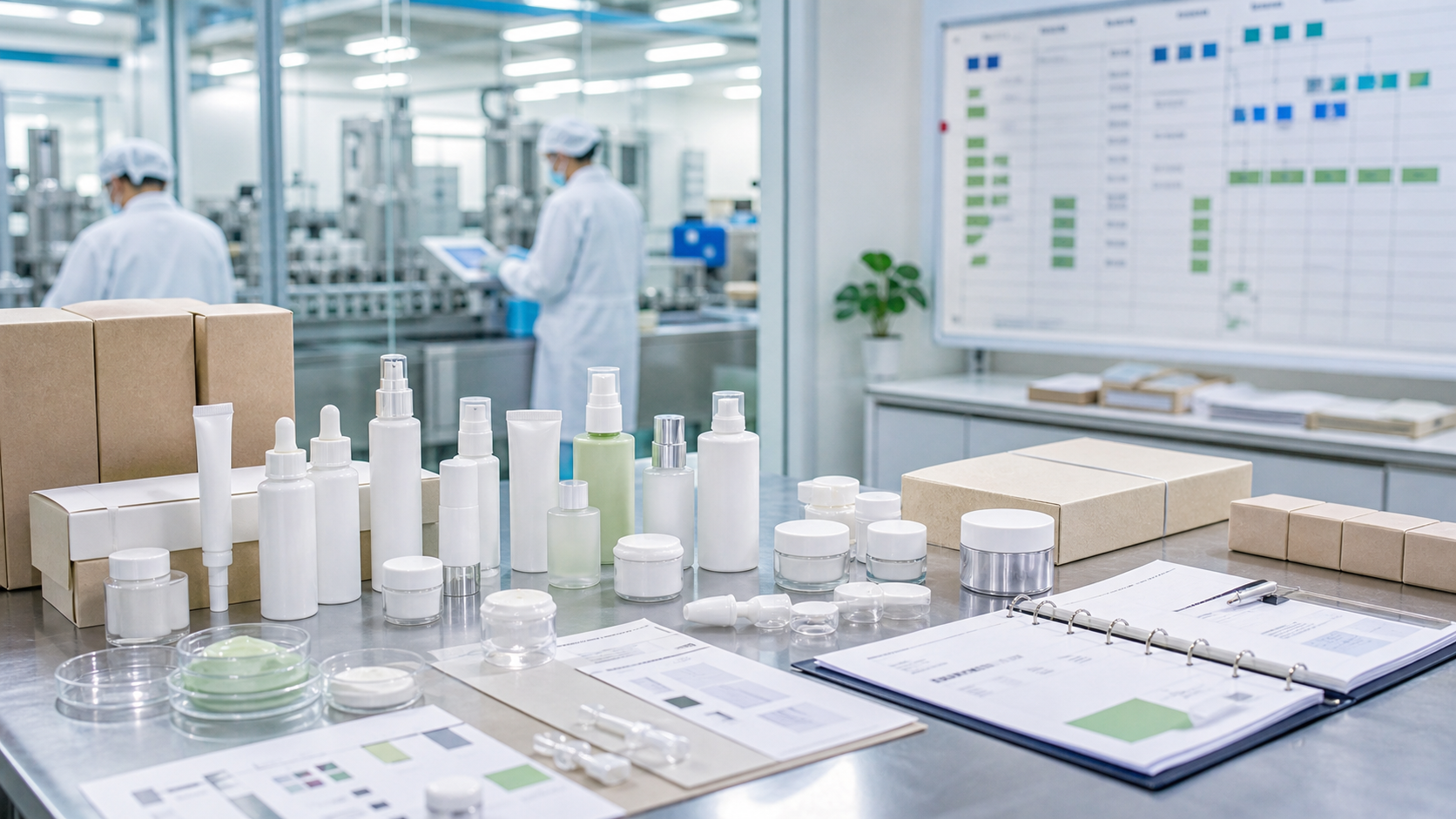
Packaging is a major part of cosmetic manufacturing. Bottles, jars, tubes, droppers, pumps, caps, labels, cartons, inserts, and shipping cartons can all affect cost, MOQ, appearance, filling, transport, and customer experience. A good factory treats packaging as part of the manufacturing plan, not as a last-minute decoration choice.
Mooyam Cosmetic’s packaging sourcing service helps buyers compare stock packaging, decorated standard packaging, and more customized options. The factory should also explain compatibility risks such as pump output, dropper pickup, tube sealing, formula contact, label adhesion, carton strength, and leakage during shipment.
For new brands, standard packaging can reduce risk and support low MOQ launches. For established brands, customized packaging can strengthen positioning, but it needs more time, supplier coordination, and approval steps.
Quality Control That Buyers Can Understand
Quality control should be visible in the process. A good cosmetic factory should explain how raw materials are received, how formulas are weighed, how production records are kept, how packaging is inspected, how filling weight is checked, and how finished goods are released. The buyer should understand which checks apply to the product and which documents can be provided.
Mooyam’s quality control and compliance support helps buyers align approved samples, batch standards, packaging checks, retained samples, and export documentation. However, no manufacturer should promise universal regulatory approval for every country. Ingredients, labels, claims, and importer responsibilities vary by target market.
Transparent Communication and Project Management
Communication quality often predicts project quality. A good factory asks clarifying questions before quoting, separates confirmed facts from estimates, and records decisions in writing. It tells the buyer what information is missing, what may affect timeline, and which choices will change cost or MOQ.
For example, if a buyer asks for a hydrating serum with a premium airless bottle, low MOQ, custom formula, vegan claim, and fast launch date, the factory should not simply say yes. It should review formula complexity, packaging availability, decoration minimums, claim support, sample timing, and realistic bulk production schedule. This protects both the brand and the manufacturer.
Export Support and Market Awareness
International buyers need more than production. They need packing lists, carton marks, shipping coordination, ingredient information, product details, and communication that supports importers or distributors. The exact documents depend on the product, market, sales channel, and buyer responsibility.
A good factory can support export communication and help the buyer understand what information is normally prepared. It should also be honest that market requirements vary. The buyer, importer, or responsible person may need local regulatory review before selling.
Buyer Checklist Before Choosing a Factory
- Confirm the factory can produce your product category and understands your target sales channel.
- Ask whether your project is best suited to private label, OEM, ODM, or custom formulation.
- Request a clear explanation of MOQ by formula, packaging, decoration, carton, and production route.
- Review sample process, number of revisions, approval standard, and timeline.
- Check whether packaging sourcing includes compatibility, decoration, leakage, and export packing review.
- Ask what quality control points, retained samples, and batch records apply to your product.
- Confirm how the factory handles changes, defects, delays, and written approvals.
- Discuss export support, target market documents, and claim responsibility before production.
Common Red Flags
Red flags include unclear company identity, refusal to explain production scope, very low prices without specifications, pressure to pay before the product brief is clear, changing bank details without formal verification, copied brand packaging, unsupported certification claims, and promises of guaranteed approval in every market.
Another warning sign is a quotation that ignores packaging. In many cosmetic projects, packaging controls cost, MOQ, lead time, appearance, and customer satisfaction. If a supplier cannot explain component options, decoration method, carton structure, or compatibility review, the buyer may face problems after samples look good.
How Mooyam Cosmetic Supports OEM/ODM Buyers
Mooyam Cosmetic supports international beauty brands with product route selection, private label skincare, custom formulation, packaging sourcing, sample development, low MOQ planning, bulk production, quality control, and export support. Our role is to help buyers build a realistic manufacturing plan instead of treating every inquiry as a generic product request.
We work with brand owners, distributors, sourcing managers, Amazon sellers, and DTC beauty teams that need clear communication and practical manufacturing support. We do not accept retail orders or single-piece purchases.
Evaluate Your OEM/ODM Project With Mooyam Cosmetic
Looking for a reliable cosmetic OEM/ODM manufacturer? Mooyam Cosmetic can help you review product ideas, formula requirements, packaging options, MOQ, sample development, bulk production, quality control, and export support. Contact us to discuss a practical manufacturing solution for your brand.
FAQ
What is the most important sign of a good cosmetic OEM/ODM factory?
The most important sign is practical transparency. A good factory explains route, MOQ, packaging, samples, quality control, timeline, and risk before production begins.
Should startups choose private label or custom formulation?
Many startups begin with private label skincare because it can reduce development risk and support a faster launch. Custom formulation is useful when the brand needs a more distinctive product.
Does a bigger factory always mean better quality?
No. Factory size is only one factor. Product fit, communication, development capability, packaging support, QC process, and export experience are also important.
How can buyers compare cosmetic manufacturing quotes?
Compare the same assumptions: formula route, fill size, packaging, decoration, carton, MOQ, sample fees, testing, quality checks, lead time, and trade terms.
Can a factory help with packaging design and sourcing?
Yes, a capable factory can help source bottles, jars, tubes, pumps, labels, cartons, and decoration options, while also checking compatibility with the formula and MOQ.
Does Mooyam Cosmetic accept retail orders?
No. Mooyam Cosmetic supports B2B brand, distributor, private label, and wholesale OEM/ODM manufacturing projects. We do not accept retail orders.