
Quick Answer: A halal cosmetics OEM project needs a controlled manufacturing workflow: define the destination and certification scope, approve ingredient sources, qualify the formula and packaging, establish suitable production controls, complete the applicable assessment, and release traceable commercial batches. Agree who owns each document and decision before paying for bulk materials. A sample, ingredient declaration or factory certificate alone does not establish that your branded finished product is covered.
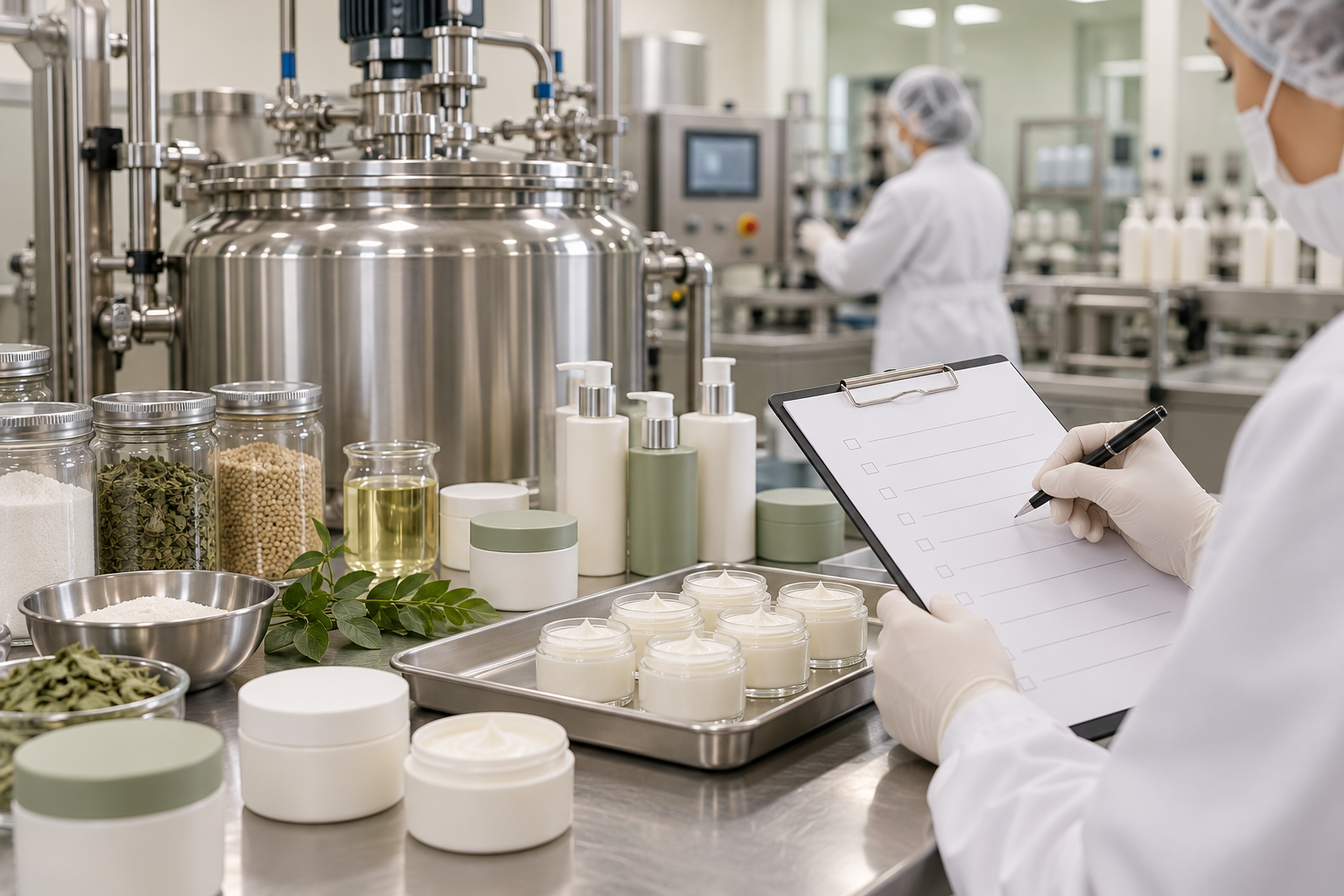
Halal cosmetics OEM manufacturing is an execution problem as much as a product development project. A brand may approve a cream’s texture while the quality team is still waiting for the origin of an emulsifier. Packaging may arrive before the permitted mark has been confirmed. A purchasing substitution can undo weeks of dossier preparation unless somebody controls the change.
This guide explains how to organize the work after defining a product brief. It is a practical planning framework, not a statement that MOOYAM or any named facility holds halal certification or offers a particular certified production service. Discuss project feasibility and evidence with your OEM or ODM cosmetics manufacturer, then confirm the applicable route with the competent authority or certification body.
Start with a written manufacturing and certification brief
Specify the intended market, legal applicant, brand, product category, manufacturing site and exact SKU family. Record whether the project uses a stock formula, a modified base or a new development. Identify who owns the formula and who may disclose confidential composition information to an assessor. These decisions determine whose documents must match the final product.
Ask the intended certification body to confirm the application scope for the real contract arrangement. JAKIM’s official circular register includes a specific contract manufacturing/OEM scheme circular from 2018 and more recent circulars. Review the current applicable instructions together; an old certificate or circular title cannot settle a new project’s eligibility.
Keep a short decision record naming the scheme, assessor, site and products to be covered. Include what must happen before a halal mark can be printed or stock can be released. Do not infer international acceptance from a familiar logo. Recognition and destination requirements must be checked for the actual route and product.
Build an ingredient register before locking the formula
| Destination context | Planning reference | Decision to confirm |
|---|---|---|
| Indonesia | BPJPH halal assurance framework | Applicable product obligations, applicant and recognized route |
| Malaysia | JAKIM procedure portal and OEM circular register | Current scheme, contract arrangement and product coverage |
| Other destinations | Competent local authority and intended certification body | Recognition, import procedure and permitted claims |
Give every raw material an internal identifier, supplier, trade name, ingredient composition reference and approved manufacturing source. Record blends at a level that allows their components and processing inputs to be assessed securely. An INCI name helps identify an ingredient but may not explain its biological source, processing aids or carrier system.
Flag materials whose source or processing requires clarification, such as animal-derived components, certain fatty derivatives, fragrances and complex active blends. This is a request for evidence, not a declaration that every material in those groups is unacceptable. Ask the assessor which supplier declarations, specifications and certificates are needed; the exact evidence depends on the scheme and material.
Track document expiry and scope where certificates are used. Check the named material, supplier site and issuing body rather than keeping a file simply called “halal certificate.” Freeze purchasing against the approved register. If a supplier offers a faster alternative, quarantine the substitution decision until technical and certification impacts have been reviewed.
Move through gates instead of promising a fixed launch date
The following sequence is an internal project structure. It is not a regulator’s guaranteed timetable. Some development activities can overlap, but dependent decisions should remain blocked until the necessary evidence is accepted. Get laboratory, packaging and assessment lead times in writing before confirming a commercial launch.
| Stage | Work to complete | Release gate |
|---|---|---|
| Scope definition | Confirm market, applicant, site, product family and applicable scheme | Written scope and responsibility agreement |
| Material approval | Collect source information and resolve ingredient evidence gaps | Approved raw material register linked to the formula |
| Development and pilot | Evaluate samples, process settings and packaging compatibility | Approved formula and documented pilot outcome |
| Assessment readiness | Prepare production controls, records and relevant application evidence | Required findings closed and applicable authorization confirmed |
| Commercial manufacture | Use approved inputs and controlled batch instructions | Quality and scope checks completed before release |
| Repeat production | Recheck changes, documents, suppliers and market requirements | Current master file and approved change decisions |
Qualify samples and packaging as a connected system
| Workstream | Required project decision | Record |
|---|---|---|
| Materials | Resolve source and processing questions with the assessor | Approved source register |
| Quality | Agree product-specific testing and acceptance criteria | Evaluation and release specifications |
| Certification scope | Confirm relevant site, product and labeling coverage | Applicable assessment decision |
| Changes | Determine review and notification before substitutions | Approved change record |
Approve sensory characteristics, application performance and appearance using a controlled sample reference. Record the formula revision, sample date and container used. A beautiful development sample in a laboratory pot does not establish compatibility with the final pump, liner or decorated retail jar.
Agree the appropriate stability, microbiological, safety and packaging evaluations for the product and destination. Halal assessment does not replace these product quality decisions. If a stability issue requires a preservative or fragrance change, return the revised materials to the approval workflow before treating the sample as production ready.
Keep artwork approval separate from graphic design approval. Confirm product name, claims, ingredient declaration, business details and mandatory statements with the relevant market reviewer. Reserve space for any permitted mark without authorizing its use prematurely. Ask the certification body how artwork and the proposed product scope must be reviewed.
Document production controls before the first bulk batch
Map material receipt, storage, weighing, mixing, filling, packing and finished goods movement. Identify where shared equipment, utensils, containers or outsourced operations introduce a control question. Have the responsible technical team and assessor determine the applicable segregation and cleaning requirements; a generic cleaning checklist cannot establish compliance by itself.
Use line clearance to verify that the correct materials and packaging are present and that remnants of an earlier job have been removed. Record material lot numbers and quantities as they are weighed. Reconcile the bulk output, filling losses and packed quantities so a finished batch can be connected to its actual inputs.
Train operators on the approved instructions and on what to do when something differs. A missing label, unapproved fragrance drum or undocumented rework should trigger a hold and investigation rather than an informal correction. Agree who can authorize rework and whether the proposed operation needs additional review before it enters production.
Make the brand and factory responsibilities explicit
The manufacturer normally controls process execution and batch evidence, while the brand controls the commercial brief and packaging decisions. The legal applicant and assessor have different responsibilities again. Write these allocations into the project agreement, including access to confidential evidence, document retention and notification of changes.
| Party | Operational responsibility | Evidence to agree |
|---|---|---|
| Brand owner | Define market and SKU brief; approve artwork, claims and commercial changes | Signed brief, artwork master and change approvals |
| OEM manufacturer | Control approved materials, production instructions and batch records | Formula revision, material register and batch release file |
| Applicant or local responsible party | Coordinate applicable filings and destination requirements | Current application scope and market checklist |
| Certification body or authority | Determine assessment requirements and decisions within its remit | Applicable written findings and certification decision |
| Shared project lead | Track dependencies, unresolved findings and handover | Gate register with named decision owners |
Release a batch with both quality and traceability evidence
Before dispatch, compare the manufactured batch with the approved master file. Check formula revision, site, material sources, finished product identity and artwork version. Review required quality results and deviations independently of the commercial pressure to ship. A purchase order deadline is not release evidence.
BPJPH’s official explanation of ongoing halal assurance emphasizes traceability across the product process and continuing implementation of the assurance system after certification. It also describes obligations concerning changes to ingredients or the halal product process. Build a change notification step into the manufacturing agreement instead of assuming that certification ends the work.
For shipment preparation, connect the batch release file to the invoice, packing list and applicable destination records. Our cosmetics export document guide explains how to reconcile product and shipment information. Destination authorization, customs documentation and certification evidence serve different purposes and must each be handled where applicable.
Control repeat orders and changes after launch
Repeat orders should begin with a short review of suppliers, composition, packaging, production site and applicable requirements. Maintain an approved version of every master record and retain superseded versions for traceability. Make it easy for purchasing staff to see which supplier and material code are permitted.
JAKIM’s official procedure portal identifies ingredients, their manufacturers or suppliers, packaging and manufacturing procedures among application information. These are useful document categories for organizing your project file; confirm the current procedure and applicable manual for the actual application.
Establish a complaint and recall communication route that reaches the brand, manufacturer and responsible market party. Test whether a batch code can identify affected raw material lots and customers without searching personal inboxes. For an initial project discussion, send the product category, intended market and development brief; feasibility and any certification scope must be established before claims are made.
Frequently asked questions
Can I use a factory’s certificate for my private label product?
Do not assume coverage. Confirm the manufacturing site, product list, brand arrangement and permitted labeling with the relevant certification body before committing to artwork or claims.
Does an approved ingredient list finish the halal review?
No. The applicable assessment may also examine processes, storage, packaging and other controls. Keep material approval connected to the way the actual finished product is manufactured.
How long does halal cosmetics OEM development take?
There is no universal duration. Formula changes, supplier evidence, testing, packaging and assessment scheduling all affect the critical path. Build a gated timeline from confirmed lead times.
Can ingredients be substituted on a repeat order?
Only through an approved change process. Review composition, source, quality and certification implications, and obtain any required notification or approval before manufacture.
Does halal certification replace cosmetic safety or market authorization?
No. Plan the applicable product safety, quality, claims and destination procedures alongside halal assessment. Assign owners to each workstream before commercial release.
Last reviewed: 18 October 2026. This article provides general manufacturing planning information, not legal advice or a certification determination. Confirm current requirements, recognition and product scope with the competent authority and relevant certification body. No certification status or certified manufacturing capability is asserted for MOOYAM by this guide.