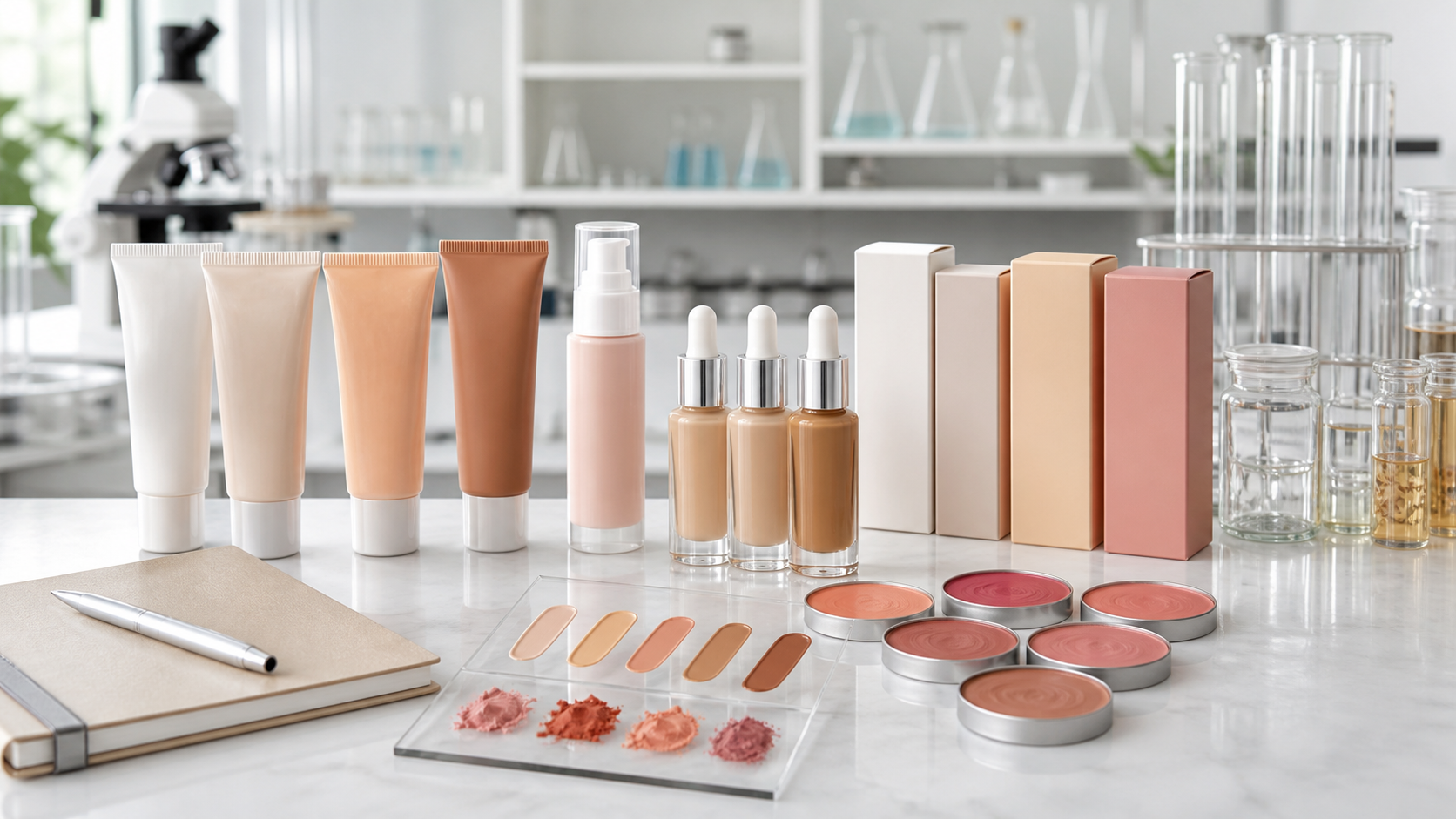
Hybrid makeup is becoming a practical product brief for beauty brands: color cosmetics that feel comfortable, support a skincare-led routine, and still perform like makeup. For OEM/ODM buyers, the opportunity is not simply adding one active ingredient to a foundation or balm. The real work is choosing the right product format, shade system, texture, packaging, testing plan, and claim language before sampling begins.
Mooyam Cosmetic develops and manufactures cosmetics and makeup for brand owners through OEM/ODM cooperation. We support formula development, color matching, packaging selection, sampling, stability review, and production planning for B2B customers; we do not sell retail orders.
Quick Summary
- Hybrid makeup works best when the brief starts with use case: skin tint, serum foundation, hydrating primer, or lip-and-cheek balm.
- Buyers should define the skincare story, finish, coverage, shade count, packaging, MOQ target, and claim limits before requesting samples.
- Mooyam Cosmetic can help translate trend demand into OEM/ODM steps from base texture and pigments to stability checks and scale-up.
- Cosmetic claims should stay truthful, supported, and not misleading, especially when skincare ingredients are included in makeup.
Why Hybrid Makeup Is a B2B Opportunity
Beauty buyers are seeing demand for simpler, lighter, skin-focused routines. Current trend coverage highlights skincare-infused cosmetics, sensorial textures, and hybrid complexion products as important directions. For a brand, this creates room for products that sit between skincare and makeup: a breathable skin tint with humectants, a primer that supports comfort under makeup, a serum foundation with a flexible finish, or a lip-and-cheek balm with cushiony pay-off.
The B2B question is whether the idea can become a repeatable SKU. Can the formula remain stable with pigments and skincare ingredients in the same system? Will the texture survive filling, shipping, and warehouse temperature changes? Can the shade range be managed within MOQ? Can the brand describe the benefit without turning cosmetic copy into a drug-style claim?
Choose the Right Hybrid Makeup Format
Hybrid makeup should not be treated as one category. Each format has different technical trade-offs, packaging fit, and buyer expectations. Mooyam Cosmetic usually starts by narrowing the product architecture before moving into color and active selection.
| Format | Best For | Development Focus |
|---|---|---|
| Skin tint | Daily complexion products with light coverage | Breathable feel, shade flexibility, pigment dispersion, comfortable dry-down |
| Serum foundation | More coverage with a skincare story | Emulsion stability, coverage level, film formers, pump or dropper compatibility |
| Hydrating primer | Makeup prep, glow, smoothing, and comfort positioning | Grip versus slip, pilling risk, compatibility under foundation |
| Lip-and-cheek balm | Compact color launches and travel-friendly sets | Pay-off, melt point, pigment staining, pan or stick fill behavior |
Formula Development: Balance Skincare Story and Makeup Performance
Start With the Sensory Target
Many hybrid makeup projects fail because the brief asks for too much at once: high coverage, skincare actives, SPF language, long wear, no transfer, dewy finish, clean positioning, and very low cost. A better brief ranks the non-negotiables. A skin tint may prioritize hydration, breathable coverage, and shade forgiveness, while a serum foundation may prioritize buildable coverage, even pigment suspension, and a satin finish.
Select Ingredients That Fit the Base
Skincare-adjacent ingredients such as humectants, emollients, barrier-supporting lipids, peptides, niacinamide, botanical extracts, or fermented ingredients can help build a product story, but they must be compatible with the makeup base. Water-based actives need a stable emulsion system. Oil-soluble ingredients must not break pigment dispersion. Powders and soft-focus agents should be tested for drag, flashback, and dry patches.
Mooyam Cosmetic can help buyers compare prototype directions rather than chasing a long ingredient list. In OEM/ODM work, a shorter and better-balanced INCI strategy often gives the brand a more reliable launch than a crowded formula that is difficult to stabilize or support with claims.
Shade Range and Color Matching Strategy
Hybrid complexion products need a practical shade plan. A small first run can start with flexible undertones and translucent coverage, while a medium or high-coverage product usually needs more precise shade depth and undertone mapping. Buyers should define the launch market before approving shades, because a shade system for Southeast Asia, the Middle East, Europe, or Latin America may require different depth distribution and undertone balance.
For lip-and-cheek balms or cream blush, Mooyam Cosmetic can prepare trend-aligned color families, but brand owners should also request pull tests on skin, paper, and final packaging to understand pay-off and batch consistency. Color approval should happen under controlled lighting where possible, not only through phone photos.
Packaging and Production Workflow
Packaging should protect the formula and support the product promise. A serum foundation in a dropper may look skincare-led, but a pump bottle may give cleaner dosage for thicker emulsions. A skin tint in a soft tube can be efficient for MOQ and filling, while an airless pump can support a more premium position. Balm formats must account for melt point, pan adhesion, cap tightness, and shipping temperature.
| Step | Buyer Decision | Mooyam Support |
|---|---|---|
| Concept brief | Format, market, price tier, hero benefit | Formula direction and feasibility review |
| Lab sampling | Texture, coverage, finish, shade direction | Prototype preparation and adjustment rounds |
| Packaging match | Tube, pump, dropper, stick, pan, carton | Compatibility checks and supplier coordination |
| Pre-production | Final shade, artwork, MOQ, lead time | Scale-up, QC standards, filling and batch control |
Testing, Claims, and Compliance
Hybrid makeup often includes skincare language, which makes claim discipline important. Cosmetic labels and marketing should be truthful, supported, and not misleading. If a product is marketed with disease-treatment, prevention, or structure/function claims, it can move outside normal cosmetic positioning in some markets. If a buyer wants SPF, acne, eczema, wound healing, or medical-style claims, the regulatory path must be discussed separately before development.
For typical cosmetic hybrid makeup, Mooyam Cosmetic recommends stability observation, package compatibility checks, microbial quality controls where applicable, color consistency review, viscosity or hardness checks, filling trials, and retention samples. For international launches, the brand owner should confirm local registration, claims, language, ingredient restrictions, and labeling obligations with qualified regulatory support.
Buyer Checklist Before Requesting a Quote
- Define the product type: skin tint, serum foundation, primer, balm, stick, cushion, or cream color.
- Choose the main benefit hierarchy: hydration, glow, smoothing, comfort, coverage, long wear, or multifunction use.
- List target markets and regulatory concerns before selecting claims.
- Prepare benchmark textures, preferred coverage level, finish, and shade references.
- Decide the first launch shade count and whether future shade expansion is planned.
- Confirm packaging type, fill volume, decoration method, carton needs, and sustainability expectations.
- Share MOQ target, launch timeline, testing expectations, and forecast volume.
How Mooyam Cosmetic Supports OEM/ODM Buyers
Mooyam Cosmetic works with beauty brands that need a manufacturing partner for cosmetics and makeup development. For hybrid makeup, our team can help transform a trend idea into a manufacturable brief: ingredient direction, texture prototypes, shade matching, packaging options, sample rounds, stability observations, production planning, and quality control standards.
Work With Mooyam Cosmetic
If you are planning a hybrid makeup launch, send Mooyam Cosmetic your target format, price tier, shade plan, packaging preference, and market requirements. We can review the brief and suggest a practical OEM/ODM development route from first sample to mass production. Mooyam Cosmetic is a B2B OEM/ODM factory and does not accept retail orders.
FAQ
Does Mooyam Cosmetic sell hybrid makeup directly to consumers?
No. Mooyam Cosmetic is an OEM/ODM cosmetic and makeup factory for B2B brand projects. We do not sell retail orders.
What is a realistic first product for a new hybrid makeup brand?
A skin tint, hydrating primer, lip-and-cheek balm, or serum foundation can be practical if the brand has a clear texture target, price tier, and MOQ plan.
Can skincare ingredients be added to any makeup formula?
Not automatically. Ingredient compatibility depends on the base system, pigment load, pH, preservative strategy, packaging, and desired texture.
How many shades should a first skin tint launch include?
For light coverage, a smaller flexible shade range may work. For higher coverage, more depth and undertone options are usually needed.
Can Mooyam help with packaging for hybrid makeup?
Yes. We can discuss tubes, pumps, droppers, sticks, pans, cartons, decoration methods, and compatibility considerations as part of the OEM/ODM project.
Trend Reference / Sources
These links are used only for trend, SEO direction, market background, and compliance context. The article above is original B2B OEM/ODM purchasing content for brand owners and does not copy, translate, or follow the structure of the sources.