
Quick Answer: To launch private label cosmetics in Australia, connect the exact formula, claims, packaging and supply route to a documented compliance review. Identify the introducing business, resolve the relevant AICIS requirements, assess the cosmetic or therapeutic pathway, and check the final consumer label. A manufacturer’s documents support these decisions; they do not create universal Australian product approval or replace the responsible business’s obligations.
MOOYAM editorial content. Last reviewed: 14 October 2026. Cover: AI-generated editorial illustration.
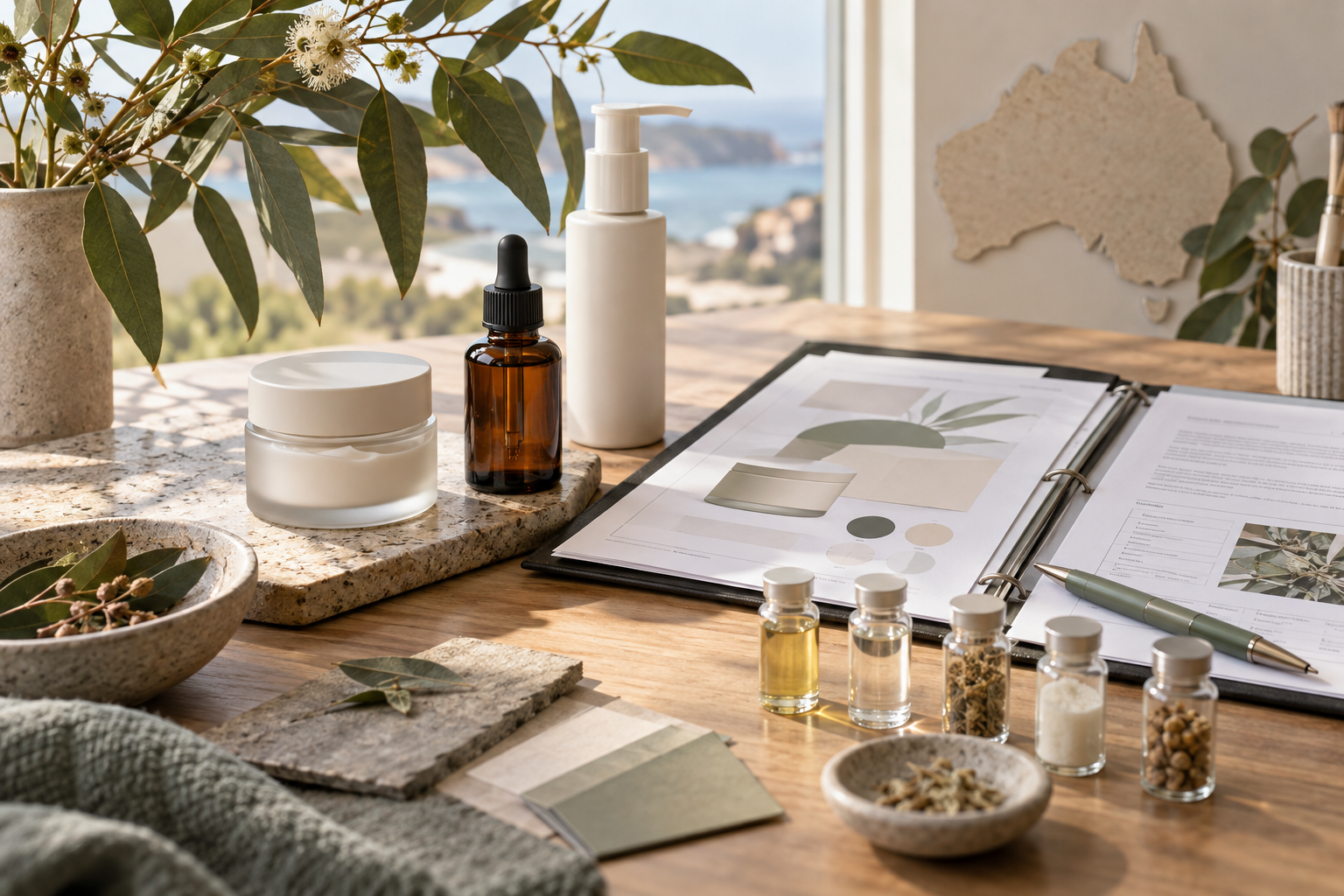
What changes when a product becomes your private label?
Private labelling combines an existing or customised formula with your brand, packaging and commercial launch. The central compliance task is connecting those elements. A product dossier for one formula does not automatically describe a later fragrance variation, a different pack or a new advertising promise. This guide focuses on that handover and the release decision, rather than repeating a complete ingredient-registration tutorial.
Start with a written Australian product brief. Include the SKU, formula version, intended use, claims, packaging format, introducing business and planned sales channels. Confirm which parts are fixed and which remain open. Our Australian launch overview provides the broader market-entry context. Treat a familiar supplier formula as a useful starting point for review, not a completed decision for every brand that buys it.
Which Australian frameworks should the launch team review?
The Industrial Chemicals Act 2019 establishes introducer registration, authorised introduction categories, reporting and records. Its scope and exclusions matter. AICIS registration concerns the business introducing relevant industrial chemicals; it should not be presented as approval of your finished cosmetic. Assign the actual introducing business before asking which registration or category evidence applies.
| Framework | Review question | Project evidence |
|---|---|---|
| AICIS / industrial chemicals | Who introduces the relevant chemicals and on what basis? | Business identity, formula-linked chemical information and pathway review |
| TGA / therapeutic goods | Does the product’s purpose or presentation raise a therapeutic pathway question? | Exact intended use, claims and classification conclusion |
| Cosmetics information standard | Does the applicable consumer ingredient information meet the standard? | Reviewed ingredient list and final packaging proof |
| Other applicable requirements | Which additional rules apply to this product and supply arrangement? | Defined review scope and unresolved-items register |
The Industrial Chemicals (General) Rules 2019 provide category, reporting and record detail. The appropriate evidence depends on the introduction. Avoid purchasing a generic “Australian certificate package” without understanding what it demonstrates. For the ingredient-introduction workstream, see our AICIS guide for cosmetic brands.
This is a launch-coordination guide, not an exhaustive list of every Australian obligation. Ask the reviewer to define coverage, exclusions and any product-specific requirements. Keep unanswered questions visible in the project register so commercial teams do not mistake an incomplete workstream for permission to proceed.
Freeze the claims before approving the formula and artwork
The Therapeutic Goods Act 1989 considers how goods are represented and their therapeutic use, subject to the applicable exclusions and determinations. A private-label name or “cosmetic” description does not settle the pathway. Review actual intended use and presentation before assuming that the manufacturer’s existing product description applies to your launch.
As a practical control, create one approved claims sheet covering the carton, bottle, website, marketplace listings and planned campaign copy. Flag disease-treatment or physiological-effect language for a qualified classification review. This is a review trigger, not a claim that every flagged phrase leads to the same regulatory outcome. Our cosmetic and therapeutic classification guide explores this boundary.
Do the review before expensive packaging production. If the claim changes, return the affected decision to its owner. A copywriter should be able to see which wording was approved and why. Store the final claims sheet with the SKU record rather than relying on an informal conversation or a supplier sales presentation.
Build a formula-to-packaging evidence file
Request documents against the exact formula version and intended packaging. Ask the factory to identify the scope, date and sample covered by each report. Separate technical records recommended for quality and coordination from documents required by a particular legal pathway. A certificate of analysis, for example, answers a defined batch-quality question; its presence alone does not establish every market requirement.
| Item to request | What to check | Hold point |
|---|---|---|
| Formula identification and ingredient information | Matches the ordered SKU and supports the agreed review | Unknown ingredient identity or untracked version |
| Relevant testing and specifications | Scope matches the product, sample and pack being evaluated | Report scope is unclear or the reviewed sample differs |
| Consumer ingredient list | Reconciles with the formula and applicable information standard | Unexplained omission or copied list from another SKU |
| Final packaging proof | Matches approved wording and is readable at actual size | Artwork differs from the reviewed proof |
| Batch and change records | Provide traceability and identify material changes | Production version cannot be linked to the file |
Agree on confidential disclosure early. If the factory cannot release detailed information to the brand, establish an acceptable route to the reviewer or responsible business and confirm that it is sufficient for the assessment. A nondisclosure agreement can help coordinate information access, but it does not answer a regulatory question by itself.
For quality planning, ask whether stability, microbiological quality and packaging compatibility work is appropriate for the formula and use. Do not label every suggested test as a universal Australian statutory requirement. The useful deliverable is a defined test scope and documented interpretation, including limitations and any additional work needed before release.
Review the final consumer label, not a supplier template
The Consumer Goods (Cosmetics) Information Standard 2020 addresses applicable cosmetic information. Its official explanatory statement explains the ingredient-list provisions, including identification, ordering, permitted names and legibility. The binding standard, including its application and exceptions, remains the basis for the review. Have the final list reconciled with the actual product.
Use a printed proof at production size. Check that folds, seams, reflective finishes and curved surfaces do not obscure the ingredient information. A readable design on a large monitor can become difficult to read on a small bottle. Confirm the relevant packaging and information requirements with the reviewer before accepting a workaround for limited label space.
Keep a signed or otherwise recorded final artwork version. If a designer shortens an ingredient name, moves information or changes claims after review, assess that revision before printing. The packaging supplier needs the exact approved production file, and the brand needs a reliable way to distinguish it from earlier drafts.
Assign responsibilities without implying that contracts transfer every duty
The most useful private-label agreement names deliverables, evidence owners and decision owners. Replace vague promises such as “compliance included” with a defined scope. Confirm which party obtains documents, which party evaluates them, and who can stop an unresolved SKU from entering production or supply. Commercial task allocation must be checked against the actual legal roles.
| Manufacturer support | Brand / responsible Australian business |
|---|---|
| Identify formula and production versions | Identify the supply route and responsible parties |
| Provide agreed technical and quality records | Arrange the applicable regulatory review and administration |
| Produce to the approved specification and artwork | Approve claims and final market presentation |
| Notify agreed formula, material or process changes | Evaluate whether decisions and records need updating |
| Support batch investigation within the agreed scope | Maintain the release record and customer-issue process |
Before release, hold a short review of the SKU file. Resolve missing documents, record any not-applicable conclusions with reasons, and retain evidence of completed decisions. Include an owner and next action for every open item. This project control supports accountable handover; it is not a substitute for a required registration, filing or authorisation.
FAQ
Does private labelling an existing formula remove Australian compliance work?
No. Your formula version, supply arrangement, claims and final packaging still need to be connected to the applicable review. Supplier experience can support the handover.
Can the factory promise Australian product approval?
Ask exactly which decision, authority and product scope the promise concerns. AICIS business registration is not universal finished-product approval.
Who should hold the compliance file?
Assign access and record ownership to the parties responsible for the relevant obligations. The brand should also maintain a coordinated SKU file so release decisions remain traceable.
Can I change claims after the artwork is approved?
Treat a claim change as a review trigger. Check its effect on classification and presentation before using the revised wording in packaging or marketing.
Which manufacturer documents should I request first?
Start with exact formula identification, sufficient ingredient information and the scope of available technical records. Then agree the additional evidence needed for the assessed pathway and quality plan.
Plan an accountable private-label handover
MOOYAM supports cosmetic OEM/ODM development, manufacturing and agreed technical documentation. Share your formula, packaging and handover needs with our OEM/ODM team or contact us. Define the manufacturing scope alongside the Australian review responsibilities before committing the launch schedule.
Regulatory requirements may change. Brands should verify current requirements with the relevant regulatory authority or qualified compliance professional before placing cosmetic products on the market.