A skincare startup may have a strong brand idea, but still struggle with the practical steps between concept and finished products. The questions usually come quickly: which formulas should launch first, how much customization is realistic, what packaging fits the budget, and how can quality stay consistent when the first order is not large?
This anonymous case study explains how a private label skincare launch can move from an early product idea to a structured OEM/ODM production plan. It is written for overseas founders, Amazon sellers, DTC brands, distributors, and sourcing managers who want a realistic view of how Mooyam Cosmetic supports brand projects. Mooyam Cosmetic serves business and wholesale OEM/ODM clients only; we do not accept retail orders.
Quick Summary
- A focused starter line is easier to sample, price, test, and reorder than an oversized first launch.
- Private label skincare can reduce development risk when the formula base, packaging, MOQ, and claims are aligned early.
- The most important work happens before bulk production: brief review, sample evaluation, packaging compatibility, artwork, and quality control planning.
- Mooyam Cosmetic can support cosmetic OEM manufacturer and cosmetic ODM manufacturer projects from product selection to export support.
Project Background: A Startup Needed a Practical Launch Path
The buyer in this example was a new beauty brand preparing to sell through a DTC website and marketplace channels. The team had a clear brand position: simple daily skincare for first-time customers, clean packaging, a moderate price point, and an order quantity that would not create excessive inventory pressure.
The original wish list included eight products, several custom fragrance ideas, multiple bottle colors, and a tight launch date. That is common for founders. A broad range can look impressive on a planning deck, but each SKU adds formula decisions, packaging sourcing, artwork, minimum order quantity, stability checks, production scheduling, and cash-flow pressure.
Mooyam’s first recommendation was to narrow the project to a launchable line. Instead of building everything at once, the startup could begin with a cleanser, hydrating toner, serum, moisturizer, and mask. This gave the brand a complete routine while keeping sampling and bulk production manageable.
Step 1: Turning a Brand Idea into a Product Brief
A useful product brief does not need to be complicated, but it must be specific. The buyer defined the target customer, expected texture, hero ingredient direction, fragrance preference, sales markets, target retail price, estimated MOQ, and first launch deadline. Those details allowed the factory to judge whether private label skincare, custom formulation, or a mixed route would be the best fit.
For this startup, the most efficient route was private label for the core line, with small adjustments in texture, fragrance, and packaging presentation where feasible. Full custom formulation was reserved for a future hero serum after the brand could validate demand. This avoided spending too much budget on a custom formula before the market response was known.
Buyers who are comparing routes can review Mooyam’s cosmetic OEM/ODM manufacturing service and private label skincare support before preparing an inquiry.
Step 2: Selecting the First Product Line
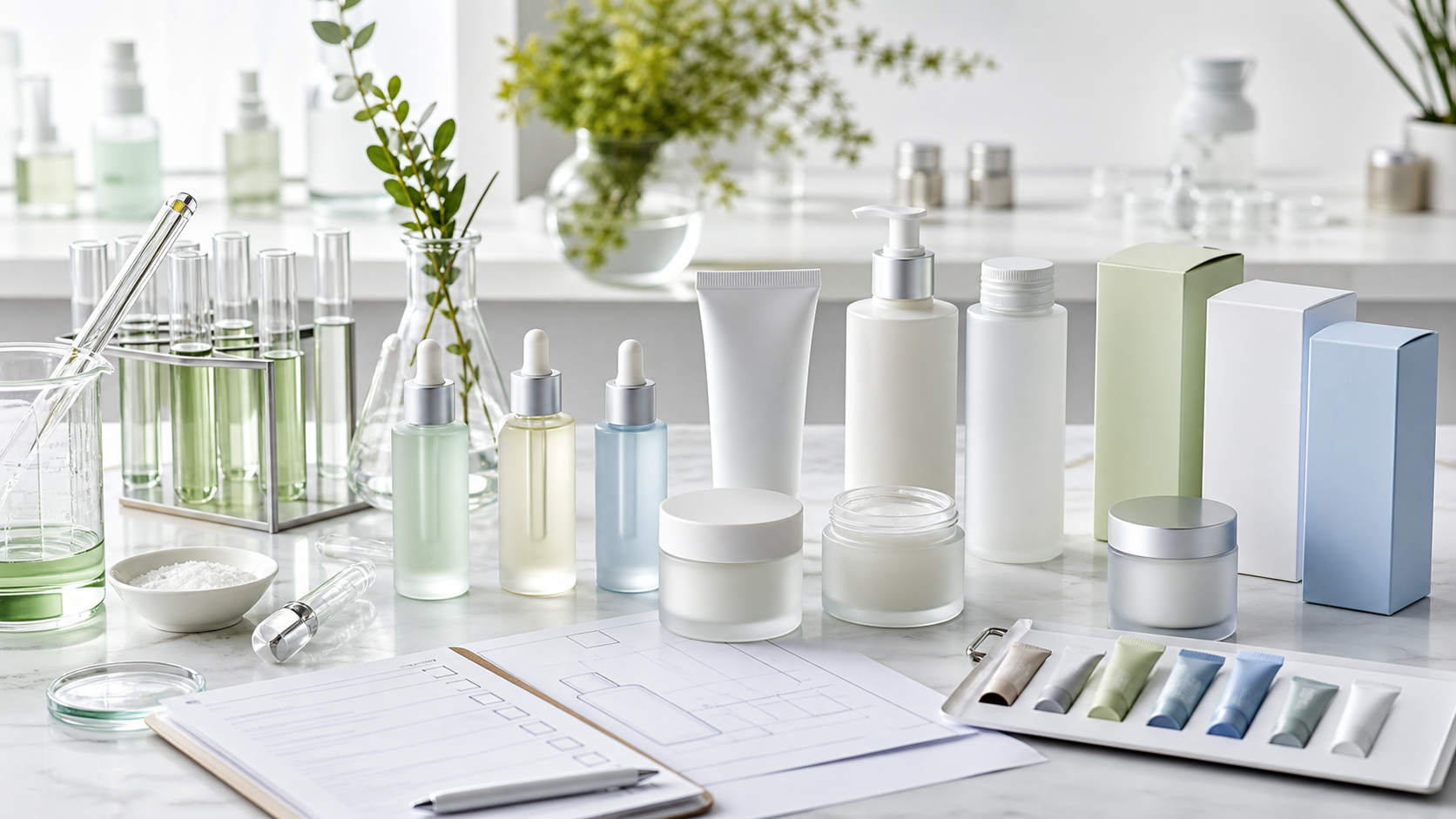
The product selection stage balanced marketing value with manufacturing practicality. A cleanser and moisturizer helped the brand cover daily-use essentials. A hydrating serum created a stronger hero product. A mask added merchandising value without requiring too many new packaging systems. The toner gave the routine a complete feel for starter sets and bundles.
| Launch SKU | Buyer Goal | Factory Development Focus |
|---|---|---|
| Gentle cleanser | Daily-use entry product for broad customers | Texture, foam level, mild feel, tube compatibility |
| Hydrating toner | Simple routine builder and bundle item | Clarity, fragrance level, bottle and cap match |
| Serum | Hero SKU for product storytelling | Viscosity, dropper or pump choice, ingredient positioning |
| Moisturizer | Core repeat-purchase product | Cream feel, jar or airless pump testing, fill weight |
| Face mask | Higher perceived value and set building | Texture stability, jar seal, usage directions, carton design |
This structure also helped the buyer compare cost. Instead of receiving a vague quotation for a whole line, the brand could see formula cost, packaging cost, decoration cost, carton cost, sample cost, and bulk production assumptions by product.
Step 3: Sample Development and Feedback
During sample development, the startup reviewed texture, odor, color, skin feel, absorption, and packaging fit. For first-time buyers, the biggest challenge is giving useful feedback. Comments such as “make it more premium” or “make it better” are hard to translate into lab action. Better feedback is specific: less fragrance, lighter viscosity, faster absorption, softer foam, warmer label color, or a different pump output.
Mooyam Cosmetic helped the buyer compare private label bases and confirm which items needed small adjustments. Where the brand wanted a more distinctive serum direction, Mooyam explained what would require custom formulation development, additional sample rounds, and more time. This made the budget and timeline easier to control.
Step 4: Packaging Sourcing and Brand Presentation
Packaging made a major difference to the final brand impression. The startup wanted a clean look, but had to avoid custom mold costs and unrealistic decoration MOQs. The practical solution was to use compatible stock packaging with coordinated label, carton, and color choices. This helped the products look like a complete brand line without forcing every component to be custom-made.
Mooyam’s customized packaging support helped compare tubes, bottles, jars, droppers, pumps, cartons, and decoration methods. The team also checked whether the selected packaging matched the formula viscosity, filling method, cap seal, and transport needs. Packaging sourcing should not be treated as a design-only decision because it affects leakage, compatibility, MOQ, and unit cost.
Step 5: Quality Control Before Bulk Production
Before mass production, the approved samples and packaging details were documented. The factory confirmed appearance, odor, texture, fill weight, packaging components, label placement, carton information, and basic inspection points. Requirements can vary by target market, so the buyer remained responsible for confirming local label, claims, notification, and importer obligations with qualified advisers.
Mooyam’s quality control and compliance information helps buyers understand typical checkpoints, including raw material control, packaging inspection, in-process checks, finished product review, and batch documentation. A startup may not need the same documentation package as a multinational brand, but it should still agree on quality standards before production starts.
Buyer Checklist from This Case Study
- Start with a focused first line, not every product idea at once.
- Decide which SKUs can use private label bases and which need custom development.
- Confirm target markets before finalizing claims, labels, and ingredients.
- Compare MOQ by formula, bottle, decoration, carton, and accessory.
- Review samples with specific feedback that the factory can act on.
- Approve packaging only after formula compatibility and filling method are considered.
- Keep reorder planning in mind when choosing packaging and shade or scent variations.
What the Startup Gained
The main result was not simply a set of products. The buyer gained a repeatable launch structure: a clear product range, controlled sampling process, realistic MOQ plan, consistent packaging direction, and documented approval steps before bulk production. That structure reduced confusion and helped the startup move from creative ideas to factory-ready decisions.
For many new brands, this is the real value of working with an experienced cosmetic OEM manufacturer. A good partner does not only fill bottles. It helps the buyer decide what to launch first, what to postpone, how to control cost, and how to avoid mistakes that appear late in production.
FAQ
Is private label skincare suitable for a startup brand?
Yes, when the startup needs a faster and lower-risk route to market. Private label works best when the brand is comfortable starting from proven formula bases and customizing presentation, packaging, fragrance, or selected formula details where feasible.
Can a startup still create a unique product with private label?
Yes, but the uniqueness usually comes from product selection, packaging, brand story, and selected customization. A fully unique formula usually requires custom formulation, more sampling, and a larger development budget.
What is the biggest mistake in a first skincare launch?
The most common mistake is launching too many SKUs before demand is proven. A focused starter line is easier to manage, test, market, and reorder.
How does MOQ affect a startup launch?
MOQ affects cash flow, inventory risk, unit cost, and packaging options. Buyers should ask for MOQ by formula and packaging component, not only one general number.
Can Mooyam help with packaging and export support?
Yes. Mooyam Cosmetic can support packaging sourcing, sample development, bulk production planning, quality control, and export communication for qualified business buyers.
Does Mooyam accept retail orders?
No. Mooyam Cosmetic works with beauty brands, distributors, private label buyers, and wholesale OEM/ODM projects. We do not sell retail single units.
Plan Your Private Label Skincare Launch
Looking for a reliable cosmetic OEM/ODM manufacturer for a startup skincare line? Mooyam Cosmetic can help with product selection, private label skincare, custom formulation, packaging sourcing, low MOQ planning, sample development, bulk production, quality control, and export support. Contact us to discuss your product idea, formula requirements, packaging options, MOQ, and production solution.