Skincare quality tests are the checks that help a beauty brand move from an attractive lab sample to a product that can be produced, filled, packed and shipped with fewer surprises. For overseas buyers, these tests are not just technical paperwork. They protect launch timing, customer reviews, reorder consistency and supplier trust.
This guide explains the main quality tests buyers should discuss with a cosmetic OEM manufacturer or cosmetic ODM manufacturer before approving private label skincare, custom formulation projects and bulk production. Mooyam Cosmetic supports brand and wholesale OEM/ODM projects; we do not accept retail orders.
Quick Summary
- Quality testing should start during sample development, not only after mass production.
- Important checks often include appearance, odor, pH, viscosity, stability, microbial review, packaging compatibility, fill weight and label accuracy.
- The exact test plan depends on formula type, packaging, market, claim language and distribution channel.
- Brands should confirm which tests are factory routine checks and which require third-party labs or extra lead time.
Why Quality Testing Matters Before Bulk Production
A skincare product can look good in one sample jar and still create problems later. Texture may thin out in heat, fragrance may change during storage, a pump may clog, a label may peel after contact with oily residue, or a jar may leak during export shipping. Quality control reduces these risks by checking the product in a structured way before the brand commits to a larger order.
For B2B buyers, testing also improves communication with the supplier. Instead of asking whether a product is “good quality,” a brand can ask which checks are included, what acceptance standards are used, what happens if results are outside specification and how batch records are kept. This is especially important for low MOQ launches where the brand may not have a large internal technical team.
Mooyam Cosmetic helps buyers connect product concept, custom formulation development, packaging sourcing and quality control into one practical project path. The goal is not to overcomplicate the launch, but to catch preventable issues before they reach customers.
Core Skincare Quality Tests to Discuss
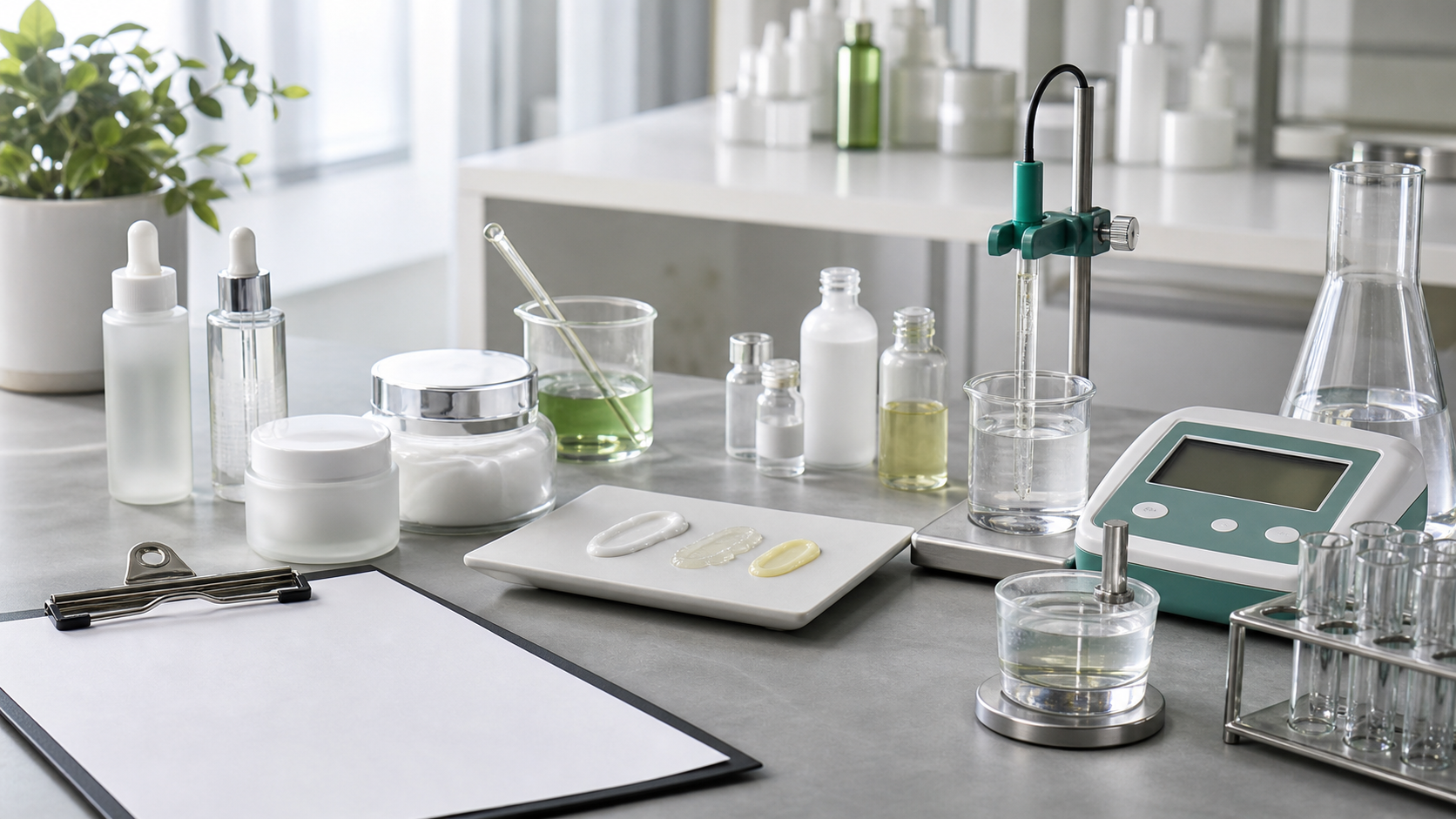
There is no single universal test list for every skincare product. A facial cleanser, serum, cream, mask, toner and balm each has different risks. Still, most private label skincare and OEM/ODM projects should begin with a core quality checklist.
| Quality Check | What It Reviews | Why Buyers Should Care |
|---|---|---|
| Appearance and odor | Color, clarity, separation, particles, smell and visible uniformity | Helps identify formula change, contamination concern or batch inconsistency early. |
| pH when relevant | Acidity or alkalinity for water-based products | Supports skin-feel targets, preservative system planning and product consistency. |
| Viscosity | Thickness, flow and texture under defined conditions | Affects filling, pump function, spreadability and repeat batch matching. |
| Microbial review | Microorganism limits and preservation performance where applicable | Important for water-containing skincare and market expectations. |
| Stability observation | Heat, cold, freeze-thaw or time-based formula changes | Shows whether texture, odor, color or separation risk appears before launch. |
| Packaging compatibility | Formula contact with bottle, jar, tube, pump, cap, liner and label | Reduces leakage, swelling, staining, clogging and label failure. |
Stability Testing Is More Than One Temperature Check
Stability testing helps determine whether the formula remains acceptable over time and under expected storage conditions. A factory may observe samples at room temperature, elevated temperature, low temperature and freeze-thaw cycles. The sample is checked for separation, color change, odor change, viscosity shift, crystallization, sediment, package swelling or pump problems.
Buyers should ask what stability conditions are appropriate for their formula and target market. A lightweight emulsion in an airless bottle, a clay mask in a jar and an oil serum in a glass dropper will not have the same risk profile. If the product will ship internationally or sell through Amazon, DTC, salons or distributors, the package may experience heat, vibration and long transit time.
Stability testing does not guarantee that a product will never change, and requirements vary by target market. It is a risk management tool that helps a brand decide whether the formula, component and claim plan are ready for launch.
Packaging Tests Buyers Often Forget
Many quality problems are packaging problems, not formula problems. A cream may pass formula checks but fail because the pump cannot handle the viscosity. A toner may be stable in a lab bottle but stain the decoration on the final bottle. A tube may look premium but crack at the cap after transport testing. This is why packaging sourcing and compatibility review should happen before final approval.
Useful packaging checks can include leakage observation, pump output, dropper pickup, cap torque, label adhesion, decoration rub resistance, carton fit, fill weight and shipping carton protection. For low MOQ products, buyers should also confirm whether the selected component has realistic lead time and whether decoration methods match the MOQ and budget.
How Testing Fits the OEM/ODM Workflow
Testing should be built into the development timeline. If a brand waits until the goods are ready to ship, there is little room to adjust the formula or packaging without delaying the launch. A practical flow starts with the brief, continues through sample development and remains active during bulk production.
| Project Stage | Buyer Decision | Mooyam Cosmetic Support |
|---|---|---|
| Product brief | Define formula type, claims, market, packaging and target price | Review feasibility, MOQ, sample route and basic QC risks. |
| Lab sampling | Approve texture, fragrance, color, skin feel and packaging direction | Adjust samples, review pH or viscosity targets and check compatibility needs. |
| Pre-production | Confirm artwork, component, specifications and acceptance criteria | Prepare production plan, reference sample and quality control checkpoints. |
| Bulk production | Approve batch based on agreed specification and inspection result | Support manufacturing, filling, packing, records and export support. |
Buyer Checklist Before Approving a Skincare Product
- Ask which skincare quality tests are included in the quotation and which are optional.
- Confirm the final packaging before stability and compatibility review.
- Keep an approved reference sample for color, odor, viscosity and texture comparison.
- Define acceptable variation instead of expecting every batch to look mathematically identical.
- Review whether claim language requires extra proof in the target market.
- Check fill weight, batch code, label information, carton protection and shipping method.
- Clarify what happens if a test result is outside specification.
Quality Control, Compliance and Claims
Quality control and compliance should be discussed clearly, especially when selling in multiple markets. Label information, ingredient naming, claims, responsible party details and notification requirements can vary by destination. Brands should avoid unsupported medical claims, guaranteed results or broad certification promises unless they have the required documentation.
Mooyam Cosmetic provides quality control and compliance support for OEM/ODM projects, but buyers should still confirm final market requirements with qualified regulatory support when needed. A practical test plan is strongest when the brand, manufacturer, packaging supplier and market advisor work from the same product brief.
FAQ
What quality tests are needed for skincare products?
Common checks include appearance, odor, pH when relevant, viscosity, stability, microbial review, packaging compatibility, fill weight, label review and batch consistency checks. The exact plan depends on the product and market.
Are all tests included in a normal OEM quotation?
No. Routine factory checks may be included, while third-party testing, special claim testing or extended stability work may require extra cost and lead time. Ask early so the quotation is clear.
When should quality testing start?
Testing should start during sampling and packaging selection. Waiting until bulk goods are finished leaves little time to solve formula, package or label issues.
Can Mooyam Cosmetic support low MOQ quality control?
Yes. Mooyam Cosmetic can support low MOQ brand projects with practical specifications, sample review, packaging checks and production QC planning.
Do skincare products need third-party lab testing?
Some projects may need third-party testing depending on formula type, claim language, buyer requirement or target market. Requirements vary, so brands should confirm before launch.
Does Mooyam Cosmetic accept retail orders?
No. Mooyam Cosmetic is a B2B manufacturer for brand owners, private label buyers, distributors and wholesale OEM/ODM projects. We do not sell retail units.
Build a Safer Skincare Launch Plan
If you are comparing suppliers for OEM/ODM cosmetic manufacturing, planning private label skincare or preparing a new custom formula, Mooyam Cosmetic can help review your product brief, testing needs, packaging route, sample development, bulk production and export support. Contact us to discuss your project requirements.