Solid skincare products give private label brands a compact, travel-friendly format that can reduce water content, simplify some packaging choices, and create a distinctive product story. For B2B buyers, the main question is not only whether solid skincare is trendy, but whether the formula, shape, packaging, claims, and production process can be made stable enough for repeat orders.
In cosmetic manufacturing, solid skincare usually refers to bars, sticks, balms, melts, and anhydrous or low-water formats designed for cleansing, moisturizing, targeted care, or routine convenience. This guide explains how overseas beauty brands can evaluate solid skincare opportunities with a cosmetic OEM manufacturer or cosmetic ODM manufacturer before starting sample development.
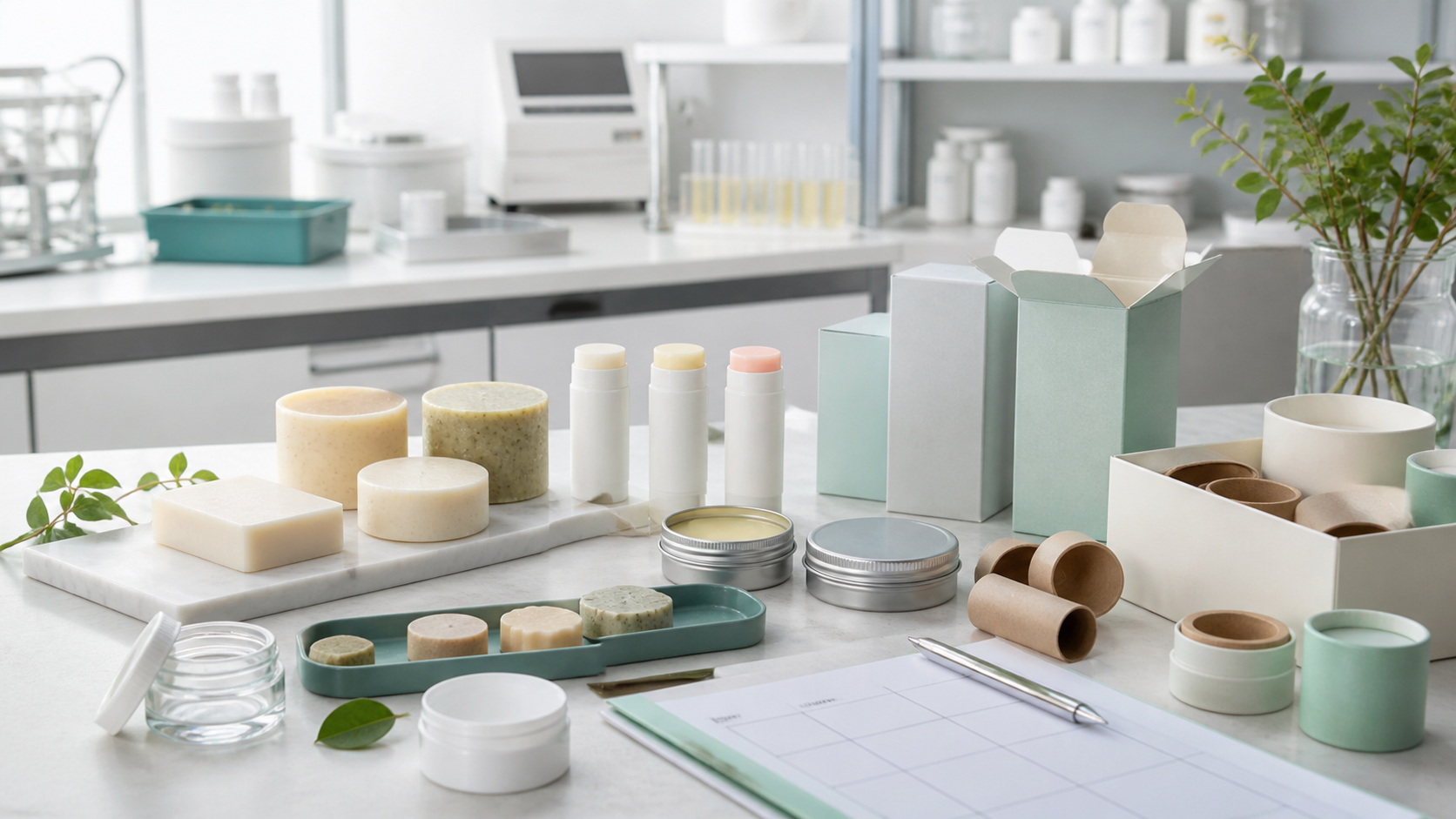
- Solid skincare can help brands create compact formats such as cleansing bars, balm sticks, body bars, solid moisturizers, and targeted care sticks.
- Development depends on formula hardness, melt point, payoff, skin feel, fragrance control, mold or filling method, packaging sourcing, and shelf stability.
- Private label skincare buyers should confirm whether a stock base, modified formula, or custom formulation best fits the brand position and launch timeline.
- Quality control and compliance requirements vary by target market, so claims, labels, testing, and import documents should be reviewed for the destination country.
What Counts as a Solid Skincare Product?
Solid skincare is not one single product type. It is a family of formats that replace a loose liquid, gel, or cream experience with a bar, stick, compressed, molded, or balm-like format. Some products are truly anhydrous, while others are low-water systems with a firm structure. The practical definition for brand buyers is simple: the product should hold its shape during storage and use, deliver the intended skin feel, and remain compatible with the selected package.
Common examples include facial cleansing bars, body cleansing bars, balm sticks, solid cleansing balms, lotion bars, massage bars, lip or cuticle care sticks, and targeted care sticks. A private label buyer may use these formats as a hero SKU, a refill concept, a travel product, a gift set item, or a channel-specific launch for Amazon, Shopify, spa retail, or boutique distribution.
Solid Skincare Formats Brands Can Consider
| Format | Best Brand Use Case | OEM/ODM Development Focus |
|---|---|---|
| Cleansing bar | Facial or body cleansing, travel routine, low-leakage e-commerce product. | Mild surfactant system, foam feel, hardness, mush resistance, pH target, fragrance stability. |
| Balm or moisturizer stick | Targeted care, handbag product, salon or spa retail, sampling set. | Melting point, glide, payoff, wax and oil balance, tube compatibility, surface finish. |
| Lotion or massage bar | Body care line, wellness brand, giftable seasonal product. | Skin feel, breakage resistance, mold release, scent control, packaging protection. |
| Solid cleansing balm | Makeup removal or double-cleansing concept for DTC brands. | Oil phase stability, scoop or stick delivery, rinse behavior, jar or tin compatibility. |
| Mini solid set | Sampling, travel retail, subscription box, promotional kit. | Small-size filling or molding, unit cost, carton layout, export packing, batch consistency. |
Why Solid Formats Are Attractive for Private Label Brands
Solid formats can help a new beauty brand look different from another serum, cream, or cleanser launch. They are easy to photograph, easy to bundle, and often easier to sample in small sizes. For Amazon and DTC sellers, lower leakage risk can also be attractive, especially when the package is designed well for shipping.
There is also a clear storytelling opportunity. A brand can position a solid product around routine convenience, refillable or minimal packaging, travel use, spa retail, or concentrated texture. However, brands should be careful with environmental claims. Packaging and formula choices can support a sustainability direction, but claims must be accurate, specific, and suitable for the target market.
A professional OEM/ODM service partner can help buyers compare stock bases, modified formulas, and custom development routes. This matters because a solid cleansing bar, a balm stick, and a lotion bar do not share the same manufacturing controls even if all of them are called solid skincare.
Formula Decisions That Affect Product Quality
Hardness, Melt Point, and Payoff
The product must feel pleasant in use while still surviving storage, shipping, and handling. A stick that is too soft may deform or sweat. A bar that is too hard may drag on the skin or fail to create the expected lather. A balm that melts too easily may look premium in the lab but become unstable in warm delivery conditions. During sample development, buyers should test texture at normal room temperature and under realistic shipping or warehouse conditions.
Skin Feel and Residue
Solid skincare must deliver a clear user experience. A cleansing bar should rinse cleanly without feeling harsh. A balm stick should glide smoothly without excessive greasiness. A lotion bar should transfer enough product without crumbling. If the brand wants a more differentiated sensory profile, custom formulation support can help adjust waxes, oils, butters, surfactants, powders, fragrance, and active-positioning ingredients while avoiding unsupported performance promises.
Fragrance, Color, and Ingredient Story
Solid formats often make fragrance and color more noticeable because the product is visible before use. Brands should decide whether the product should look natural, colorful, spa-like, clinical, or playful. The ingredient story should support the format and the sales channel. For example, a wellness line may prefer botanical oils, while a minimalist DTC brand may prefer a fragrance-free or low-fragrance direction. Any claim language should be reviewed carefully because cosmetic requirements vary by target market.
Packaging Sourcing for Solid Skincare
Packaging should be discussed at the same time as the formula. A balm stick needs a mechanism that can push the product cleanly without cracking. A cleansing bar may need paper wrap, carton, sleeve, tin, or molded tray protection. A lotion bar may require a container that protects the surface from dust, melting, or edge damage. The selected package affects MOQ, cost, lead time, fill weight, artwork area, export carton strength, and how the product appears in marketplace photos.
Through customized packaging sourcing, buyers can compare paper cartons, tins, jars, tubes, push-up sticks, labels, sleeves, inner trays, and gift set layouts. Packaging should not be chosen only for appearance. It must match the formula hardness, filling or molding method, product weight, shipment route, and the brand’s reorder plan.
OEM/ODM Development Workflow
A solid skincare project should start with a detailed product brief. The buyer should define the target product type, use scenario, skin feel, scent direction, package preference, market, price range, MOQ target, and launch deadline. For faster private label skincare, the factory may suggest an existing base formula and packaging options. For a more original line, a custom formulation route may be more appropriate.
After the brief, the factory prepares lab samples and packaging samples for review. Buyers should evaluate hardness, melting behavior, application feel, scent, surface finish, package fit, label area, and transport protection. Once the formula and package are approved, the project moves to pilot checks, artwork confirmation, mass production, quality control, final inspection, and export support.
Buyer Checklist Before Starting Samples
- Choose the exact solid format: cleansing bar, balm stick, lotion bar, solid cleansing balm, or mini set.
- Define the target customer, sales channel, price range, and whether the product is a hero SKU, add-on, or gift item.
- Prepare reference products and explain what should be matched, improved, or avoided.
- Confirm texture targets such as hardness, glide, lather, melt point, residue, scent level, and surface appearance.
- Decide whether to use a stock base, modified base, or custom formulation route.
- Review packaging options early, including component MOQ, artwork area, carton strength, and shipping protection.
- Ask how quality control will check appearance, weight, hardness, odor, stability, packaging defects, and retained samples.
- Discuss target-market claim and labeling requirements before final artwork, because compliance expectations vary by market.
Quality Control and Export Considerations
Solid products need quality control points that fit their format. A cosmetic factory should check raw material condition, batching accuracy, heating or mixing process, mold or filling weight, cooling or setting time, surface appearance, odor, color, package fit, leakage or sweating, and final packing condition. For repeat orders, retained samples and batch records help the buyer compare future production against the approved standard.
Mooyam Cosmetic provides quality control and compliance support for B2B projects, including practical checks before shipment. For export support, buyers should also confirm packing details, carton dimensions, product information, documents requested by freight partners or importers, and any market-specific label or claim review needed before sale.
FAQ: Solid Skincare Product Development
1. Are solid skincare products easier to manufacture than creams or serums?
Not always. Solid products may avoid some liquid leakage issues, but they introduce other controls such as hardness, melt point, mold release, filling weight, surface finish, and package fit. The factory should evaluate the format before quoting.
2. Can a brand start with a private label solid skincare formula?
Yes, if the available base formula fits the product concept, target price, packaging, and market. A private label route may shorten launch time, while custom formulation is better when the brand needs a unique texture, ingredient story, or sensory profile.
3. What packaging works best for solid skincare?
It depends on the format. Cleansing bars may use wraps, cartons, tins, or trays. Balm sticks need compatible stick mechanisms. Lotion bars may need tins or protective boxes. Packaging sourcing should be checked with the formula, not after approval.
4. How should brands test solid skincare samples?
Test appearance, scent, hardness, use feel, melting behavior, package fit, shipping protection, and storage performance. Brands should also review the sample after several days or weeks because surface sweating, scent changes, or cracking may appear later.
5. Can solid skincare support low MOQ launches?
Sometimes. MOQ depends on formula batch size, mold or filling setup, packaging supplier MOQ, printing method, and whether custom colors or components are required. Buyers should ask for the MOQ drivers, not only the final number.
6. Are solid skincare products automatically more sustainable?
No. They may support reduced water or lighter packaging concepts, but sustainability claims must be specific and supported. Final label and claim requirements vary by target market, so brands should avoid broad or guaranteed environmental claims without review.
Develop Solid Skincare with Mooyam Cosmetic
Looking for a reliable cosmetic OEM/ODM manufacturer in China? Mooyam Cosmetic can support solid skincare projects from product brief, private label skincare selection, custom formulation, packaging sourcing, sample development, mass production, quality control, and export support. Contact us to discuss your product idea, formula requirements, packaging options, MOQ, sample development, and production plan.
Related manufacturing guides: For product launch planning, consider small-batch cosmetic manufacturing and clean beauty manufacturing.